What Is Uptick Chain? A Public Chain That Brings the Real World Onchain
Published on Oct 13, 2026
Most public chains are waiting for goods. Uptick Chain is manufacturing them. This piece answers three questions: what kind of chain it is, why it believes it can safely carry real assets, and why “getting real-world assets onchain” is the hardest nut in the entire RWA space.
Contents
- What it looks like: a “dual-VM” public chain
- Three and a half years, and one counterintuitive number
- The real difficulty: what “asset” actually means onchain
- One judgement, and the thing it has thought through
- Three positions you rarely see
You probably know the coffee-shop experience well: order, pay, and a few minutes later you are cycling away on a bike. Nothing in that flow asks you to trust anyone — because there is a coffee shop, a delivery platform and a payment rail, and each does its own step properly.
But suppose one day you say, “I want to sell the washing machine downstairs the same way.” Things suddenly jam. Not because the technology cannot do it, but because nobody knows: who owns it, how you prove ownership, how many times it changes hands per day, whose fault it is when it breaks, and what it can actually do once it is onchain.
That is the single problem Uptick Chain sets out to solve.
1. What it looks like: a “dual-VM” public chain
Two concepts first, because everything after depends on them. A virtual machine (VM) is where contracts execute — Ethereum runs the EVM, Solana runs SVM. Cosmos SDK is not a virtual machine. It is a framework for building blockchains, together with a system of native modules: good performance, native IBC cross-chain capability, customizable modules. But it does not, by itself, give contracts an execution sandbox.
With that distinction in place, the choice becomes clear:
- EVM only: large Solidity ecosystem, many developers, easy liquidity access — but weak scalability and privacy, and when one transaction congests the chain, everyone waits.
- CosmWasm only: the WASM sandbox performs well and Rust gives memory safety — but the ecosystem and toolchain are thin, and early on you build everything yourself.
Uptick Chain’s answer is: don’t choose — take both. That is “dual VM.”
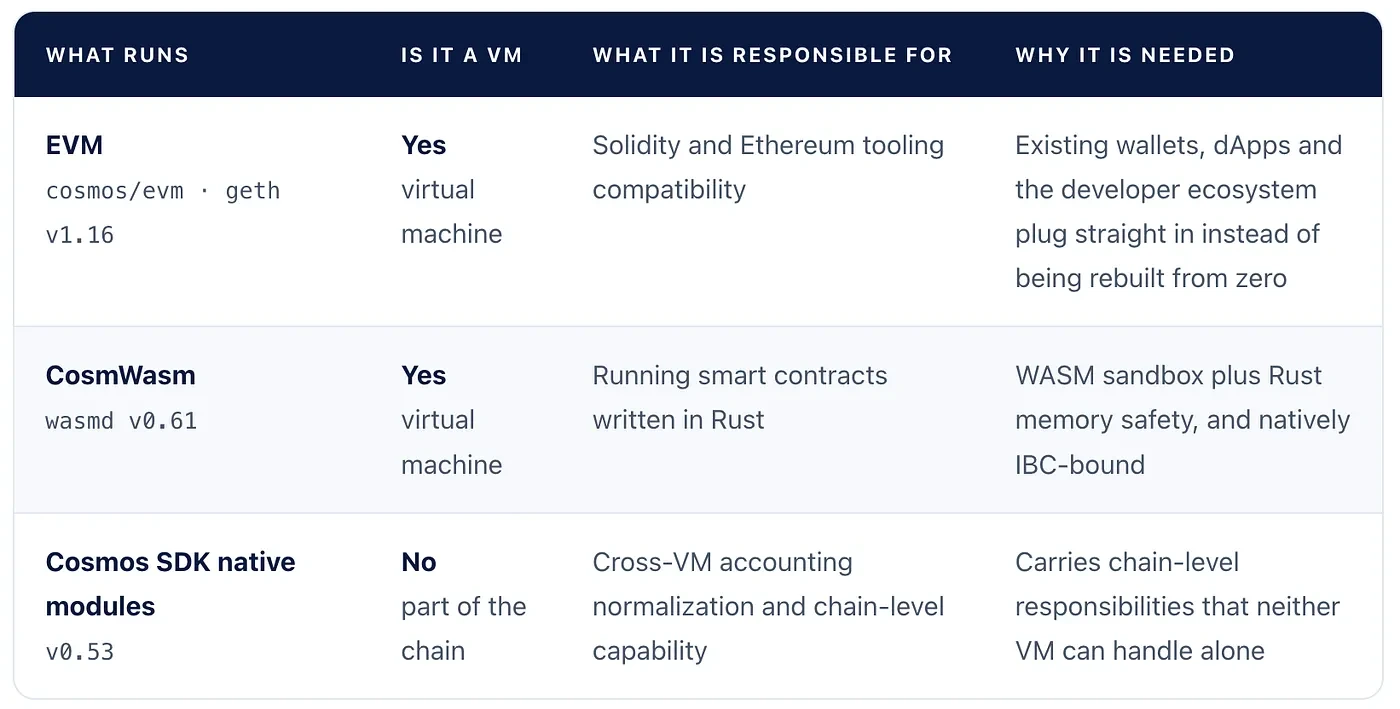
Beyond the two VMs it has a third thing: native Cosmos SDK modules (not a VM, but part of the chain itself). So the accurate description is “two VMs plus a layer of native modules”:
Press enter or click to view image in full size
Please read that table carefully: “dual VM” refers to the first two rows — EVM and CosmWasm. The third row, Cosmos SDK native modules, is not a virtual machine; it is part of the chain itself.
And that is exactly where the crux lies. Contracts in the EVM and contracts in CosmWasm are two separate worlds. How do you make the same asset add up correctly in both, without the two ledgers fighting? The answer is Cosmos SDK native modules — they sit above both VMs and normalize. Per public sources, this “two VMs plus a native normalization layer” combination is currently rare in the Cosmos ecosystem.
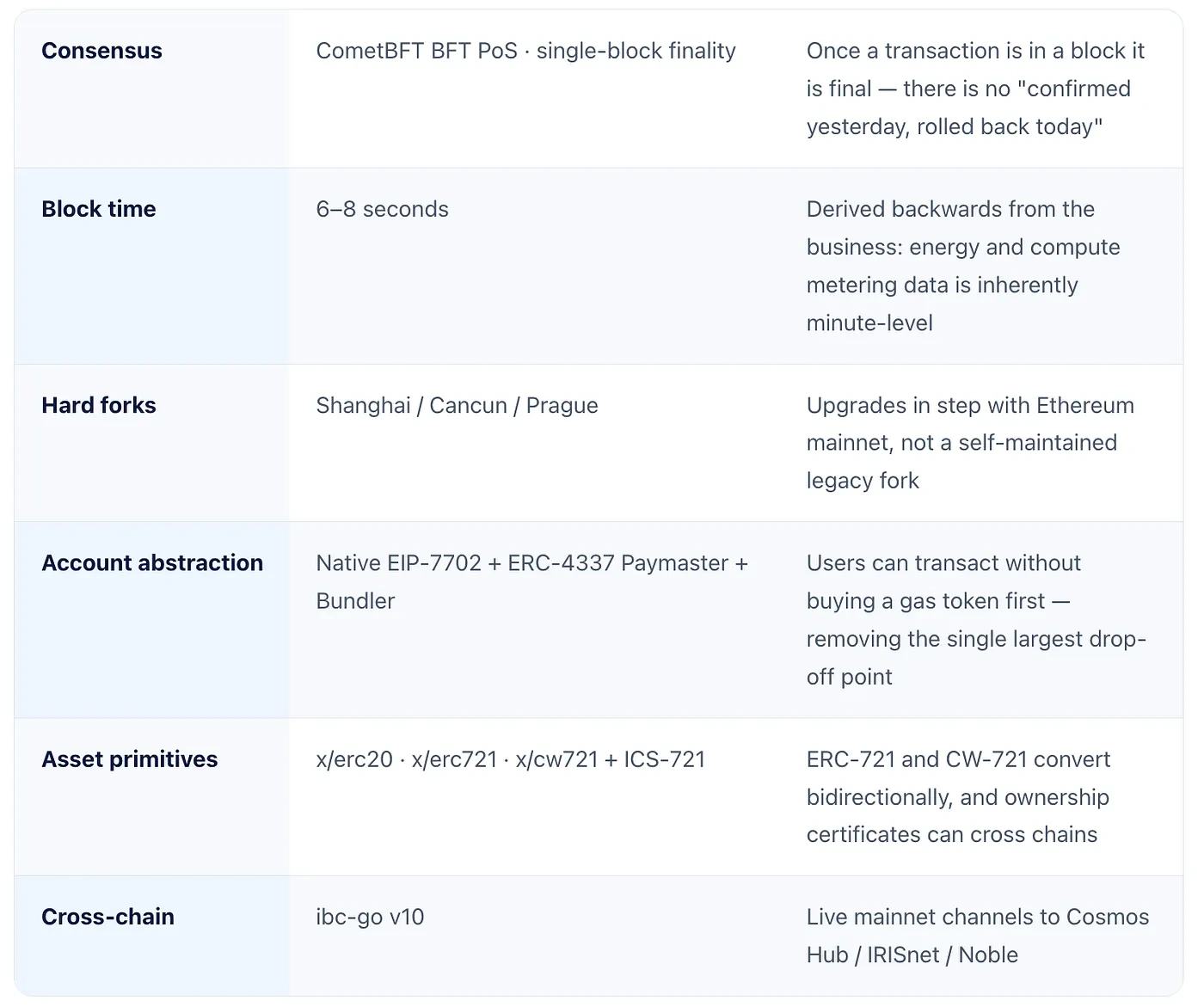
Several other parameters worth knowing:
Press enter or click to view image in full size
The dryness here is deliberateFor RWA, “performance” is not the metric that matters most. Whether the books add up, whether anything can roll back, and whether it can be audited — those are what matter.If an onchain asset certificate can be rolled back, it is not a certificate. It is a fit of temper.
2. Three and a half years, and one counterintuitive number
Chains have a brutal rule: launching is easy; surviving three years is hard.
A great many public chains died of “easy to launch, hard to operate”: nodes dropping, state desync, cross-chain bridges getting hacked, consensus bugs. That is not a failure of engineering skill. It is the simultaneous drain of time and money — and most projects never reach their second major release.
Chain ageMainnet live since March 2023, as of October 2026~3.5 years of continuous operation · 21 formal releases · zero major haltsThe project started in 2021 and has been continuously funded for five years.
One more number deserves separate mention: in August 2026, v0.4.0 moved the EVM engine onto Cosmos’s official mainline implementation.
The weight of that decision lies in what it means: the EVM side of this chain is no longer a fork the team maintains itself, but something that follows the official Cosmos mainline. In industry language, that is called shedding legacy-fork risk.
Put another wayThis team did not treat “we will carry an increasingly un-upgradeable EVM fork forever” as a sustainable plan. In 2026, that is still rare.
3. The real difficulty: what “asset” actually means onchain
This is the most important section of the piece, and the one most RWA projects have not explained clearly.
Many projects say “we do RWA,” which sounds like scanning a contract and uploading it. But in practice, the very first layer is already a thicket of questions:
Right type | What right does this token represent?
Ownership, a beneficial yield right, or a right of use? The three differ enormously, and their legal consequences differ entirely.
Who measures | Who is responsible for metering?
How much power a battery puts out per hour — is that the grid’s call, the equipment vendor’s call, or a third party’s?
Data origin | How do you prevent tampering?
Numbers reported by sensors can be edited directly; and even with an oracle, someone still has to feed the oracle.
- How are the days the equipment is down counted? What if the subsidy policy changes? When the asset is retired, how does the onchain certificate get cancelled?
- What about cross-border and cross-jurisdiction? Where is the asset, where is the jurisdiction, and who adjudicates a dispute?
The dividing lineWriting an ERC-20 contract takes less than two hours.Answering all of the above correctly across the legal, engineering and governance dimensions simultaneously is what it actually takes to call something “asset onboarding.”
Uptick’s answer compresses to one sentence: turn the cost of customization from “rebuild it per asset” into “configure it once.”
This is the through-line behind every technical choice it makes — build a reusable set of chain-level capabilities (metering, ownership confirmation, authenticity verification, cross-VM accounting, cross-chain transfer) so that adding a new asset vertical means filling in configuration rather than rebuilding from scratch. Whether the cost converges decides whether this can scale.
It has already walked real assets
· Real data produced on mainnet — not a demo
Energy RWA — generation volume and storage capacity tokenized, live on mainnet
· BESS / VPP virtual power plant — AI-driven storage dispatch and aggregated operations, live on mainnet
· AI compute assetization — dual-certificate design for compute assets plus an SPV bankruptcy-isolation structure, live on mainnet
· Trade finance / receivables — non-standard asset matching, oracle and KYC in one integrated stack
4. One judgement, and the thing it has thought through
There is a phenomenon almost every observer notices:
The entire Web3 industry spent the past few years crowding into the financial side — DEXes, lending, derivatives, stablecoin trading. The pipes are extremely good, extremely many, and arguably overbuilt.
But there is nothing in the pipes.
However lively the financial side gets, without tradeable, priceable, financeable real assets onchain it is spinning in place. And most genuinely valuable real-world assets — every kilowatt-hour a power plant generates, every hour of battery capacity stored, a factory’s real receivables, one machine-hour of AI compute — still sit in spreadsheets, contracts and sensors.
So Uptick Chain’s strategic judgement is this: value concentrates at the very top of the funnel, in the asset-onboarding layer. The difficulty there is not technical; it requires deep industry cognition and execution capability on the industrial side — and that is precisely the thing capital cannot build quickly.
Following that judgement, the path has three layers
Layer 1 · Onchain it — Real assets → verifiable, divisible, traceable onchain certificates
The most valuable parts of the world — data-driven real assets, and the production, trade and lifestyles around them — are brought onchain as verifiable, divisible, traceable digital certificates. This layer solves whether it can get here at all.
↓ Output: standardized, measurable, continuously updatable onchain assets
Accumulate · Grow onchain · Ecosystem ops
Layer 2 · Grow it onchain — Onchain assets → integrated into the onchain ecosystem
Getting onchain is only the start. This layer lets assets stay “alive” onchain — continuously measured, continuously updated, genuinely used by the ecosystem: traded, staked, paid with, derived from, read by AI. Assets are no longer merely stored onchain; they are genuinely integrated into onchain production and daily life.
↓ Output: live assets with real use cases and ecosystem support
Standardize · Financialize · Screen
Layer 3 · Connect to onchain finance — Standardized assets → flow naturally into onchain finance
Any asset meeting standardization and financialization criteria — clear cash flows, complete yield structure, priceable and divisible, compliance-cleared, already connected to settlement rails — is naturally accepted by the maturing onchain financial system and enters lending, matching, derivatives and insurance. We do not select assets on behalf of financial markets; we simply keep feeding qualified assets in.
↓ Output: onchain financial asset expansion → feeds the ecosystem and the next onboarding wave
The flywheelLayer 3 happens automatically — a pool that never fills is never short of a screening mechanism; it is short of supply.Once this mechanism spins up it becomes a flywheel: more onchain financial assets → a more attractive ecosystem → more real assets → a bigger pool.
5. Three positions you rarely see
A good technical piece should not only list capabilities; it should state what the authors chose not to do. These three reveal more about a project’s character than any capability list.
No chain tax on applications
This is not a charitable pose. It is an acknowledgement of a repeatedly verified fact: taxation drives ecosystems to other chains. Uptick’s revenue comes from deep services around asset onboarding and from protocol capability — not from taking a cut of someone else’s application.
Open source
The code is open on GitHub under Apache-2.0. Half the trust cost of infrastructure comes from whether you can inspect it yourself.
No attempt to own the ecosystem
The stated posture is to provide the chain, protocols, tooling and methodology and build alongside ecosystem partners — not to harvest the ecosystem into something proprietary. The more concrete expression of this: at the identity, payment-authorization and liquidity layers, it deliberately interfaces with existing standards and networks rather than inventing a parallel stack.
In one sentenceUptick Chain is a public chain running two virtual machines — EVM and CosmWasm — with a layer of native modules above them, and its mainnet has run stably for three and a half years. What it actually sets out to do is bring real-world assets onchain in batches, grow them onchain, and let the qualified ones flow naturally into onchain finance.Its most consequential judgement is this: the world ends up onchain eventually — but only if there is genuinely something onchain.So when you evaluate this chain, it may be worth asking a different question — not “how much return can it generate”, but “how far is it from actually bringing the real world onchain?”

