Web3 Infra Series | An RWA's History Is Part of Its Value
Published on Mar 25, 2026
When a private equity firm presents a real estate fund to
institutional investors, the most persuasive document isn’t the
financial model, it’s actually the track record, the historical
performance of previous funds, the audit trail of distributions made
on time, the documented decision-making process behind every material
asset management choice, and the verifiable record of how the team
handled the moments when things didn’t go according to plan.
History is what transforms a promising investment into a credible one,
and credibility is what separates assets that attract patient,
long-term capital from assets that attract only speculative interest
from investors willing to accept opacity in exchange for the
possibility of massive returns.
The first generation of tokenized real world assets largely ignored
this dynamic, treating provenance and track record as secondary
concerns, with the industry focusing on proving that tokenization
technology even worked at all. The result was a market full of tokens
that technically functioned, but struggled to build the investor trust
that genuine secondary market depth requires, because the
infrastructure for creating, preserving, and communicating an asset’s
verifiable history on-chain was never built alongside the tokenization
layer itself.
Most exhibited low trading volumes, long holding periods, and minimal
secondary market activity. The problem wasn’t that the assets were
bad, it was that investors had no reliable way to verify whether they
were good, because the on-chain history that would let any investor
anywhere query an asset’s performance, audit its distributions, and
trace its governance decisions simply didn’t exist in a form that was
continuous, tamper-proof, and independent of whatever the issuer chose
to report.
RWA 2.0 is built on a different premise.
An asset’s on-chain history should not be a compliance artifact or an
operational byproduct, it is a core component of the asset’s value,
and that building the infrastructure to create and preserve that
history from day one is the actual work this market has been building
toward since the first bond settled on-chain back in 2018.
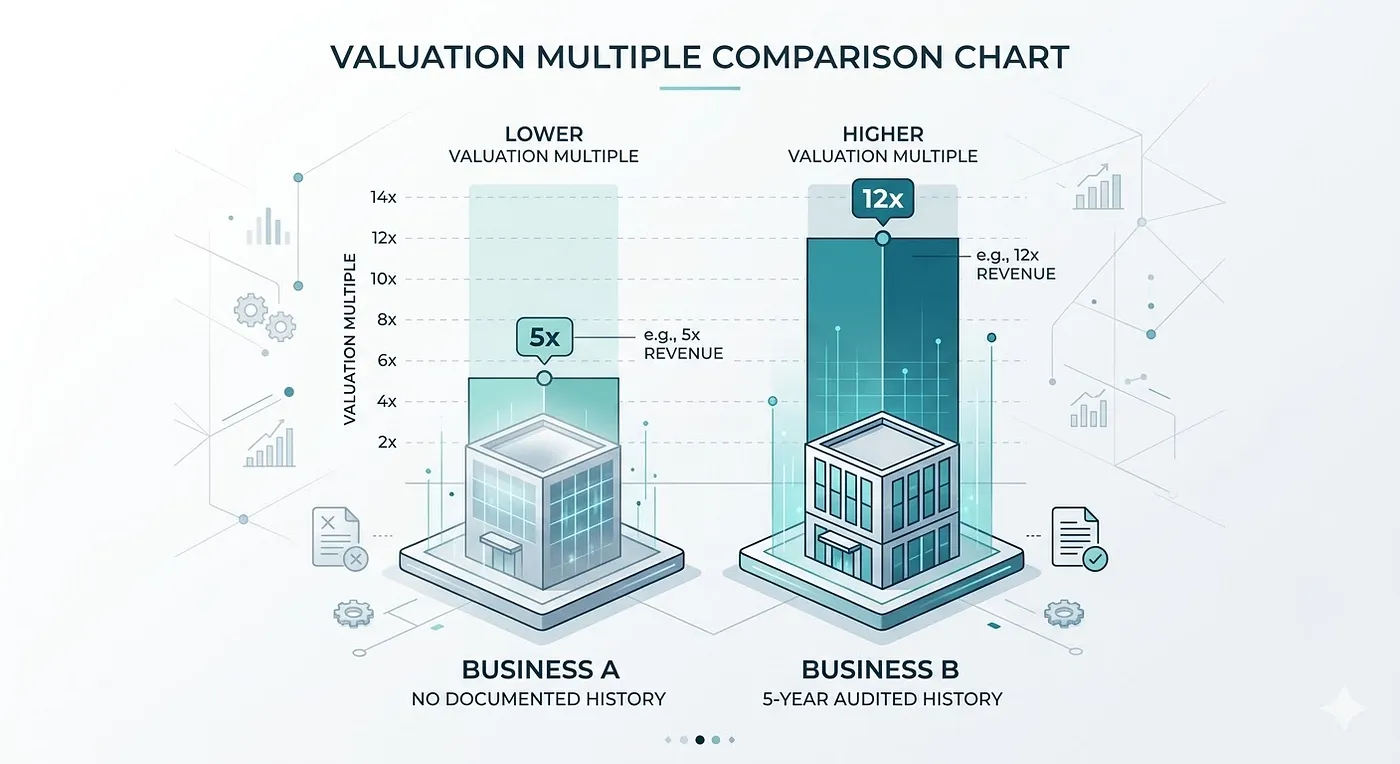
Every business owner understands intuitively that a company with five
years of audited financials commands a higher valuation than an
identical business with no documented track record, because the
history doesn’t simply describe past performance, it provides the
evidentiary foundation that allows investors to form confident
expectations about future performance, and confident expectations are
what justify premium valuations and patient capital commitments.
Tokenized assets should work the same way, and in RWA 2.0
infrastructure they do, but first-generation tokenization created a
rather strange situation where assets that had real operating
histories in the physical world arrived on-chain as blank slates, with
no continuous performance record, no verifiable distribution history,
and no tamper-proof audit trail that an investor could query
independently of whatever the issuer chose to include in their
quarterly report.
The gap between the history a business owner knows their asset has and
the history they can actually prove to a global investor is where
enormous amounts of potential value get lost, because investors who
can’t verify a track record independently will either ask for a
discount to compensate for the opacity or just flat out decline to
participate altogether.
Both outcomes are worse for the business compared to building the
infrastructure to make that history fully transparent from day one.
Uptick’s Decentralized Data Analytics Service creates the continuous,
immutable on-chain record that transforms an asset’s operating history
from a narrative the issuer controls into a verifiable dataset that
any authorized investor can query at any time.
Every income event, every valuation update, every fund flow can be
recorded with cryptographic permanence, so the asset’s history
accumulates on-chain as it operates rather than existing only in
documents that could be selectively presented or retrospectively
adjusted.
For a business owner, every month of strong performance makes the
asset more valuable in a way that investors can independently verify,
compounding credibility alongside returns in a way that the
traditional reporting model never could.
Liquidity is the challenge that every RWA business faces and almost
none has genuinely solved.
The core reason is simpler than most infrastructure discussions
acknowledge, which is that secondary market buyers are making
decisions with less information than primary investors had, and assets
without a transparent, queryable on-chain history force secondary
buyers to either trust the issuer’s characterization of performance,
or conduct expensive independent due diligence that makes small and
mid-sized transactions economically unviable.
Traditional financial markets solved this problem through standardized
reporting requirements, rating agencies, and regulated disclosure
frameworks that created enough information consistency for secondary
markets to function, but those systems took decades to develop,
require expensive intermediaries to maintain, and still produce the
quarterly reporting cycles and selective disclosure practices that
give sophisticated institutional investors information advantages over
everyone else.
On-chain history changes this dynamic entirely, because when an
asset’s complete performance record is continuously updated on a
tamper-proof ledger that any investor can access directly, the
information asymmetry that suppresses secondary market participation
largely disappears.
A secondary buyer looking at a tokenized asset with two years of
unbroken on-chain distribution records, verified governance decisions,
and auditable fund flows is in a fundamentally different position than
a buyer looking at a token backed only by an issuer’s representations,
and that difference shows up directly in willingness to pay and depth
of secondary market participation.
That is the difference between an asset with a market and an asset
with a price tag nobody trusts.
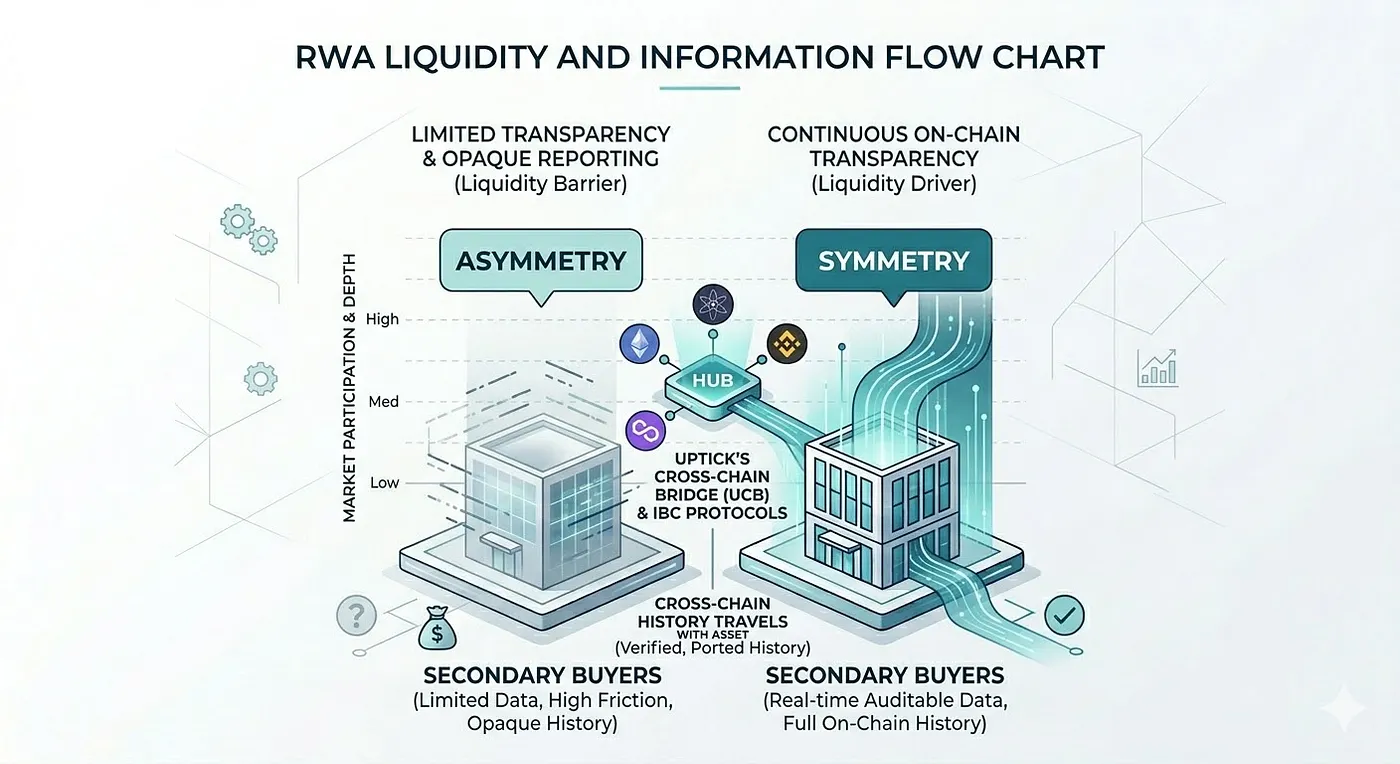
Uptick’s Cross-chain Bridge (UCB) and IBC protocols mean that an
asset’s verified history travels with it across ecosystems, so UCB is
able to bridge to Ethereum, Binance Smart Chain, Polygon, etc, and IBC
enables interoperability across the Cosmos Ecosystem. The credibility
built up on one chain doesn’t disappear when the asset moves to reach
investors across Ethereum, Cosmos, Binance Smart Chain, Polygon
markets, and more.
The history remains intact and verifiable regardless of which
ecosystem a secondary buyer is operating in, which means every
additional month of clean on-chain history makes the secondary market
for that asset deeper rather than leaving it dependent on periodic
issuer communications that tell investors only what the issuer wants
them to know.
Every RWA business owner who has tried to build genuine secondary
market activity has run into the same wall, which is that compliance
verification resets with every transaction, requiring each new
transfer to trigger the same KYC and AML processes that the original
investor completed months or years earlier.
This turns what should be a continuous market into a series of
discrete transactions each requiring its own manual compliance review.
The cost of this friction is also strategic, because secondary market
depth is one of the most important signals a tokenized asset sends to
prospective primary investors, and an asset that demonstrably trades
actively and fairly commands better terms on future raises than one
where secondary activity is suppressed by infrastructure that makes
trading harder than it needs to be.
The better approach treats compliance not as a gateway that resets
with every transaction, but as a verified history that the investor
carries with them, and this is the part of Uptick DID that matters
most to asset issuers. When investors carry verifiable credentials
built on W3C standards that prove their eligibility through selective
disclosure, their compliance history travels with them across every
transaction, so transfers complete automatically when both parties
carry valid credentials without triggering a new manual review process
each time.
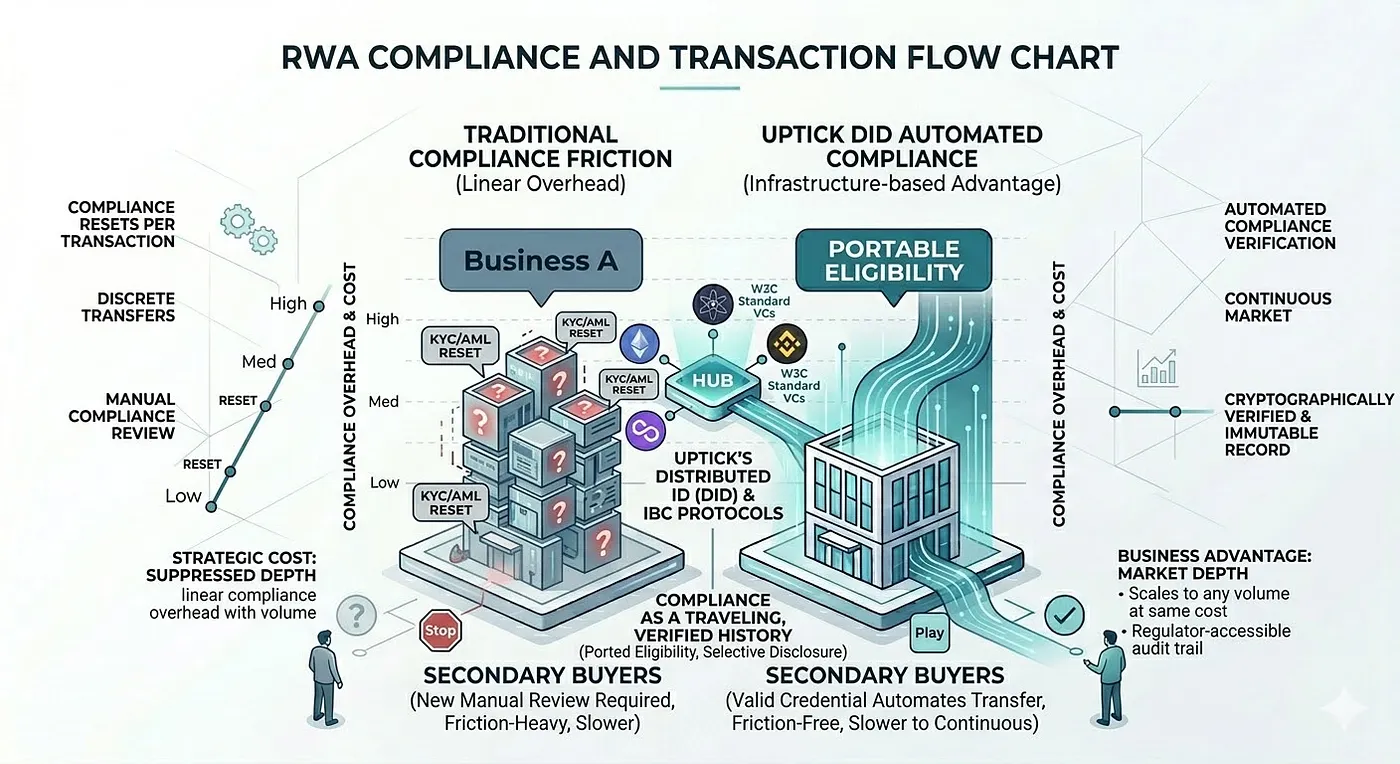
The audit trail this creates is actually much better than manual
compliance reviews, because every transaction is cryptographically
verified and immutably recorded rather than dependent on a compliance
team’s documentation practices, and the entire record is
regulator-accessible without requiring the issuer to maintain and
produce separate compliance documentation on demand.
The compliance overhead that currently scales linearly with
transaction volume gets replaced by infrastructure that handles any
volume at the same cost, and secondary market activity stops being a
compliance problem and starts being a business advantage.
One of the most consistent failures in first-generation RWA platforms
was treating token issuance as the conclusion of the business process
rather than the beginning of an ongoing relationship.
It left issuers with essentially no tools for engaging token holders
after capital was raised, no mechanism for rewarding long-term
commitment, and no structured way to demonstrate to prospective
investors that existing investors were satisfied enough to deepen
their participation over time.
This matters for a reason that every business owner recognizes
immediately, which is that the most credible evidence you can show a
prospective investor is a satisfied existing investor who has
increased their commitment over time, and building the infrastructure
that creates those investors is one of the highest-return investments
a tokenized asset business can make.
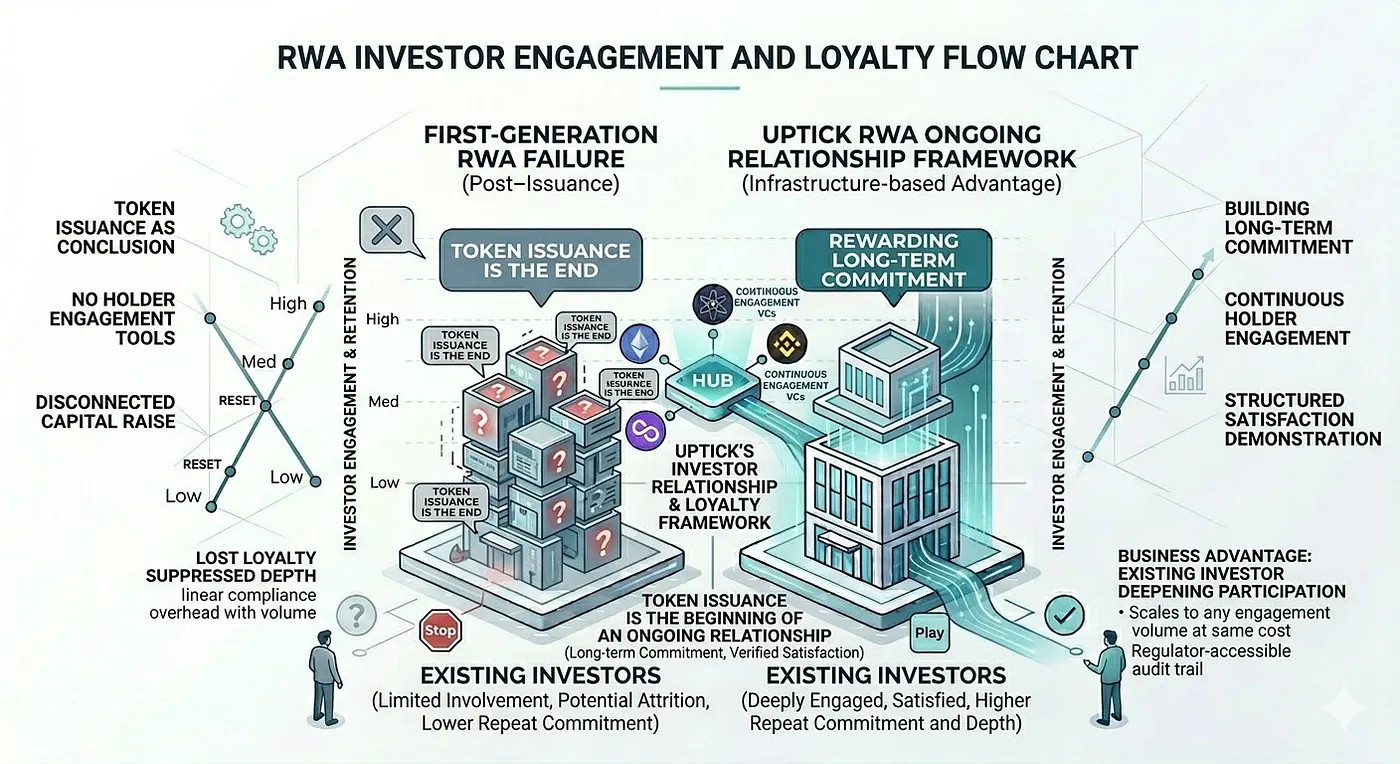
Uptick’s Decentralized CRM (DCRM) gives RWA businesses the tools to
build that investor track record systematically, storing interaction
data securely on IPFS with cryptographic access controls and
automating meaningful responses to investor behavior through smart
contracts that create a documented history of how the business treats
its capital partners.
A fund that automatically unlocks enhanced reporting access for
investors who have held tokens through multiple distribution cycles,
distributes governance weight proportional to holding duration, or
rewards investors who participate actively in governance votes, is
building a verifiable record of investor experience that prospective
investors can examine before committing capital, which is a more
credible form of investor acquisition than marketing materials
describing what the experience will be like.
The Loyalty and Rights Management module makes these relationships
programmable at scale, so the history of an investor’s engagement with
the asset, how long they have held, how actively they have
participated, how consistently they have reinvested distributions,
becomes the basis for the privileges they receive, turning the
investor relationship into something that compounds in value for both
parties rather than remaining static from the moment capital was first
committed.
A business that can show prospective investors what its existing
investors actually do, rather than what they were promised, is
operating from a completely different position of credibility.
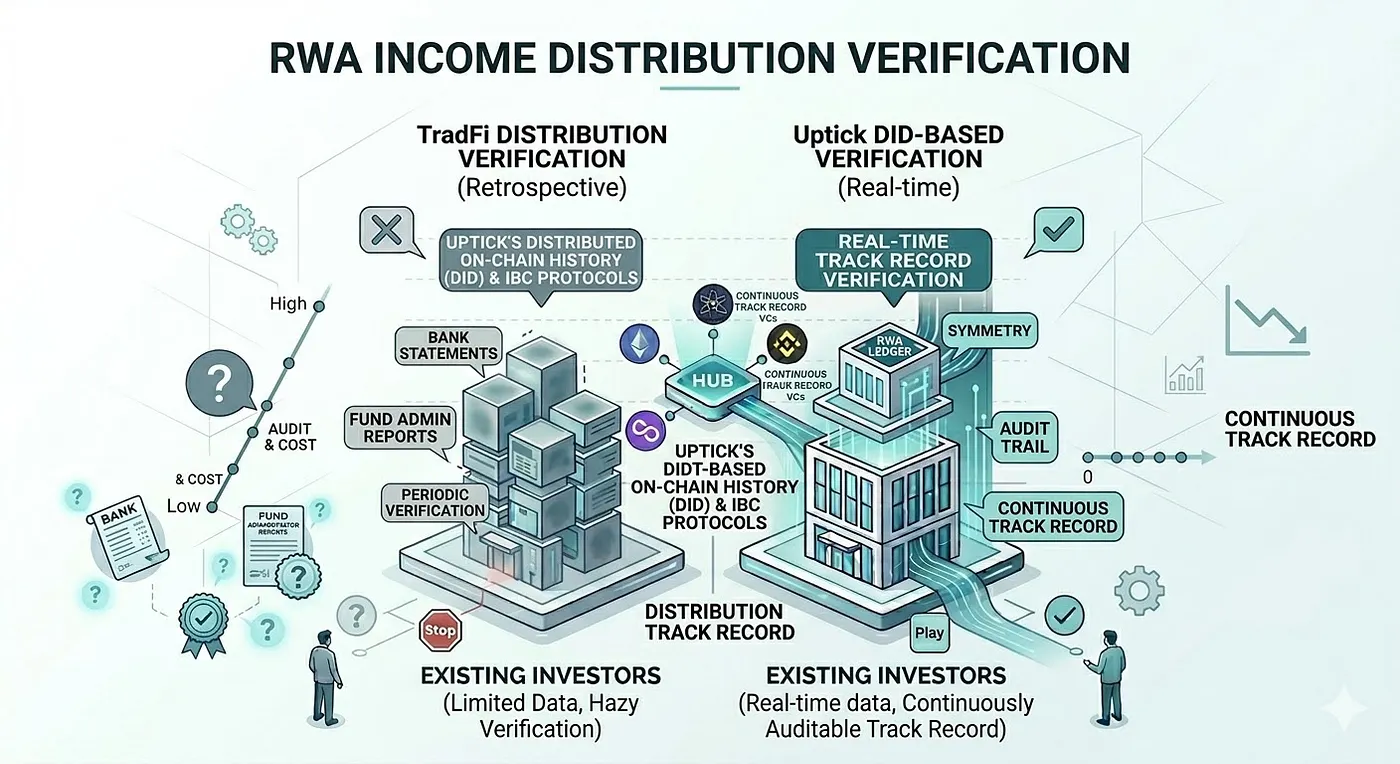
The clearest test of any asset manager’s track record is simple: did
investors receive what they were promised, when they were promised it,
without having to chase anyone for it. In TradFi, this record exists
in bank statements and fund administrator reports that investors
accumulate over years and that auditors verify periodically, but the
verification is always retrospective, always dependent on third
parties whose interests aren’t perfectly aligned with accuracy, and
always presented in formats that make systematic comparison across
assets and time periods difficult.
On-chain distribution history changes all three of those things,
because when income distribution runs through smart contracts that
execute automatically and record every payment immutably on a public
ledger, the distribution track record is continuous rather than
periodic, independently verifiable rather than dependent on
administrator reports, and presented in a standardized format that
makes comparison straightforward for any investor evaluating the
asset.
There’s no chasing, no waiting, and no administrator’s word required.
Uptick’s Omnichannel Payment Module creates this kind of distribution
history at scale, supporting income distribution in multiple
cryptocurrencies, stablecoins, and fiat-backed assets across different
Web3 ecosystems through a single payment infrastructure layer.
For example, a commercial real estate fund collecting rental income
might distribute automatically to token holders in whatever currency
they prefer, with every payment recorded immutably on-chain and the
entire distribution history accumulating as a verifiable track record
that any prospective investor can examine before making a commitment.
The fund administration layer that typically extracts 1 to 2% annually
for processing distributions more slowly and less transparently gets
replaced by infrastructure that creates a better distribution record
at lower cost, and every on-time payment strengthens the asset’s
history in a way that directly supports its valuation on the secondary
market.
The governance record of a tokenized asset, every material decision,
every vote, every policy change, and the process by which each was
reached, is increasingly relevant to both investors evaluating the
asset and regulators overseeing the market, and most first-generation
tokenized assets have no meaningful governance history at all because
decisions were made in the same opaque, undocumented ways they would
have been made in a traditional fund structure.
For a business owner building a tokenized asset platform, the absence
of a verifiable governance history creates two concrete problems. The
first is investor confidence, because sophisticated investors
evaluating a platform that has been operating for two years want to
understand how material decisions were made during that period, what
the process was, whether token holders had input, and how outcomes
compared to what was promised, and a platform that can only offer
“trust us, we made good decisions” is at a significant disadvantage to
one that can show a transparent, auditable governance record.
The second is regulatory risk, because governance documentation
requirements are tightening across every major jurisdiction as
regulators develop frameworks for tokenized securities, and platforms
that built proper governance infrastructure from the beginning are
substantially better positioned than those that need to retrofit it
later.
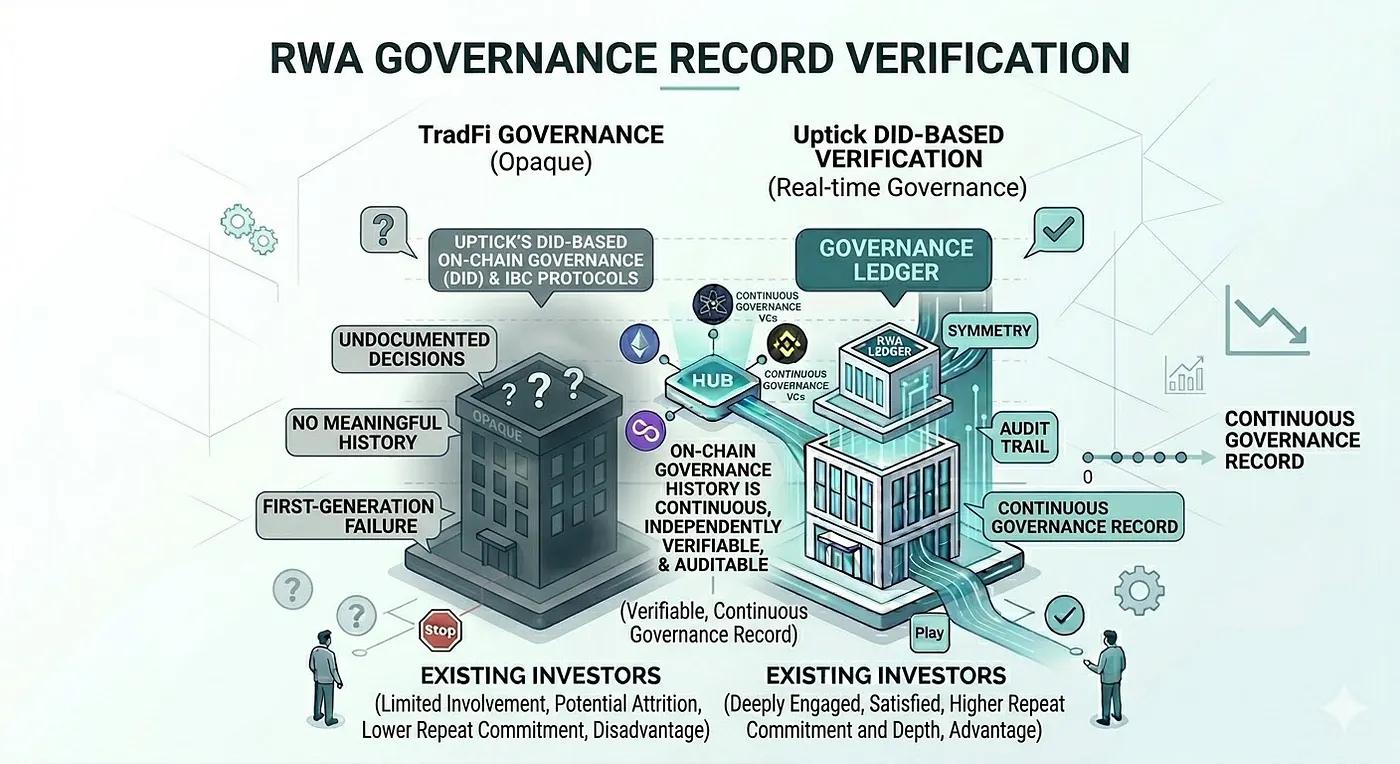
Uptick’s Social DAO infrastructure means governance is recorded
automatically as the asset operates, with every proposal, vote, and
outcome recorded immutably on-chain in a format that is permanently
auditable by investors and regulators without requiring the issuer to
maintain separate documentation systems or produce governance records
on demand.
Combined with Uptick DID, governance participation is verified and
privacy-preserving at the same time, as only eligible token holders
participate in each vote and the record of their participation is
cryptographically secured without exposing personal data to other
participants or to the public record.
An asset with two years of clean, transparent, on-chain governance
history is a more credible and defensible investment than an asset
that made the same decisions through the same undocumented process
that traditional fund managers have always used, and that credibility
gap compounds over time in exactly the same way that a strong
distribution history does, making the asset more valuable to secondary
market buyers and more attractive to primary investors in future
raises with every governance cycle that passes.
The governance record doesn’t just protect you from scrutiny. It
becomes the reason investors choose you over everyone else.

Every business owner who has raised capital understands that the
second raise is easier than the first, the third easier than the
second, and the compounding advantage of a strong track record is one
of the most durable competitive advantages in asset management.
The firms that raise the most capital over long periods aren’t
necessarily those with the highest returns in any single period, they
are the ones whose investors trust them consistently across many
periods, and that trust is built on history, on the documented,
verifiable record of doing what they said they would do for long
enough that no reasonable investor can question it.
RWAs should work the same way, and with the right infrastructure they
do, because every distribution paid on time, every governance decision
made transparently, and every investor relationship deepened through
consistent treatment accumulates as an on-chain record that makes the
asset more credible and more valuable with every passing cycle.
That infrastructure is what RWA 2.0 actually is, and building in this
direction has been part of Uptick’s core vision for a long time.