Uptick Insight Series | Why RWA Records Have to Travel With the Asset
Published on Jun 10, 2026
Most RWA discussion gravitates toward the easiest headlines because
tokenized treasuries, real estate, and blue-chip funds easily map onto
TradFi, and institutional pilots signal that the category has moved
past theory, but those examples also pull attention away from the
parts of the market where tokenization has to prove itself through
repeated use rather than recognizable asset names.
The stronger pressure sits inside normal business operations, in the
timing of cash flows, the handling of invoices and receivables, the
replenishment of inventory, the management of supplier relationships,
and the accuracy of asset records, ownership data, and reporting
baselines that keep companies running. These details rarely show up in
narratives, but they decide how money moves in practice, how much
trust has to be rebuilt by hand, and where systems start to fail when
stressed.

Large issuance in familiar asset classes signals that the market is no
longer theoretical, but it doesn't settle the operational question
underneath it. Most businesses care less about whether another
prestige asset gets tokenized than whether payments arrive on time,
stock gets replenished, working capital holds, claims can be financed,
counterparties behave, and money doesn't get stuck between systems
that don't align.
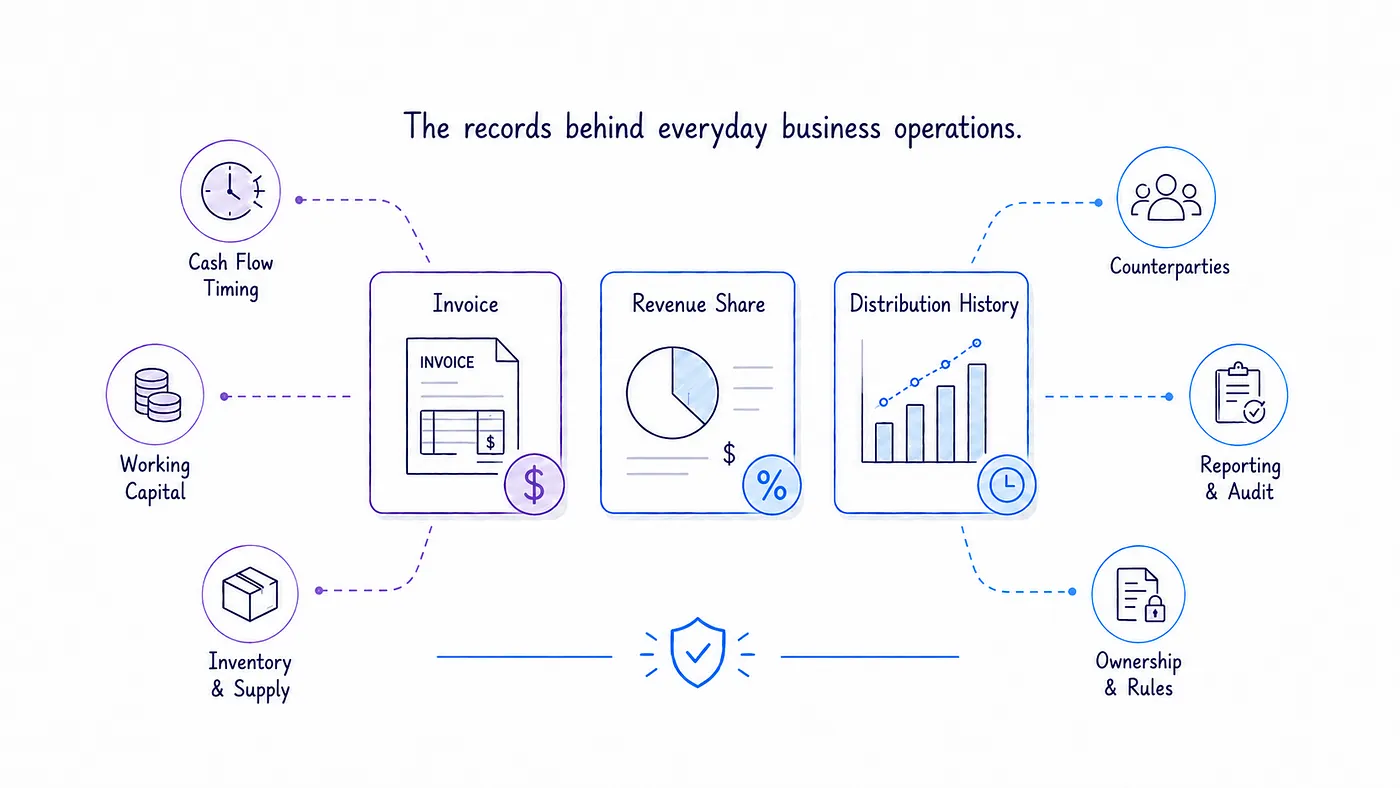
Those problems sit much closer to daily commercial pressure. An
invoice isn't exciting, a revenue share tied to an operating business
isn't really that exciting, and a clean distribution history is also
not that exciting, but these are the assets and records businesses
understand immediately because they already live with the consequences
when payment history, ownership, rules, and supporting evidence fall
out of sync.
The longer an asset operates, the more information accumulates around
it, which means the cost of reconstructing that history keeps growing
when the record is disconnected across different systems. Uptick is
designed around that pressure, where the job isn't to create more
tokens, but to let an invoice, claim, or revenue share keep its rules,
payment logic, permissions, and supporting history attached to the
asset record as it moves across transactions, counterparties, and
systems. A counterparty receiving that invoice or revenue share should
be able to check the payment record, verify ownership, and read the
current rules through the asset record, instead of waiting for someone
to rebuild the context somewhere else.
An asset can look attractive on day one and still weaken as a market
opportunity if the operational layer around it is poor, because
investors might like the asset but still struggle to understand what
has happened since issuance. Payments arrive, but the record of those
payments is split across different places, governance decisions get
made, but the process is hard to verify, and updates sit inside
emails, PDFs, spreadsheets, administrator reports, or platform
accounts that don't travel with the asset.
Many early tokenization efforts looked weaker than expected because
key business logic still lived outside the token, leaving the asset
with an on-chain representation while the evidence needed to evaluate
it still sat in the same disconnected systems the market was supposed
to improve.
A single payment tells you very little, but years of distributions,
transfers, and governance updates create a growing administrative
friction point when every new counterparty has to reconstruct the
record before they can trust it. The longer the asset operates, the
more expensive that gap becomes, because the history that should make
the asset easier to evaluate becomes another thing the market has to
rebuild by hand.

Businesses don't adopt infrastructure because it looks more
sophisticated, they adopt it because it removes work they were already
doing, and that work becomes visible at the worst moments, when
records don't match, reports have to be assembled under pressure, or a
transfer creates uncertainty about who controls what.
Those pressures accumulate through routine activity, which means
infrastructure gets judged less by what it enables at issuance and
more by how much operational overhead it removes afterwards. When a
distribution runs late or a rule changes, the problem is not only the
event itself, but the extra work required to prove what happened, who
approved it, what record changed, and whether the current owner is
looking at the same version as everyone else.
The practical difference shows up in the review cycle, when a late
distribution, changed rule, or ownership transfer becomes part of the
same operating record the next participant has to check, rather than a
separate clean-up job for the business managing the asset, shifting
the work from assembling evidence after the fact to maintaining a
record that keeps absorbing the events that would otherwise become
reconciliation problems later.
Issuance gives the market a visible starting point, with an issuer,
headline number, asset class, launch, chain, announcement, and
wrapper, and those signals help the market decide what looks credible
at the beginning, but they don't really answer whether anyone can
still verify what happened after the asset has moved beyond the
institution that issued it.
That question gets harder once assets start moving, because
distributions continue, ownership changes, governance decisions
accumulate, and records pass through systems that weren't designed to
preserve context for each other, which means an asset can look
straightforward at launch and become increasingly difficult to
evaluate as those events pile up.
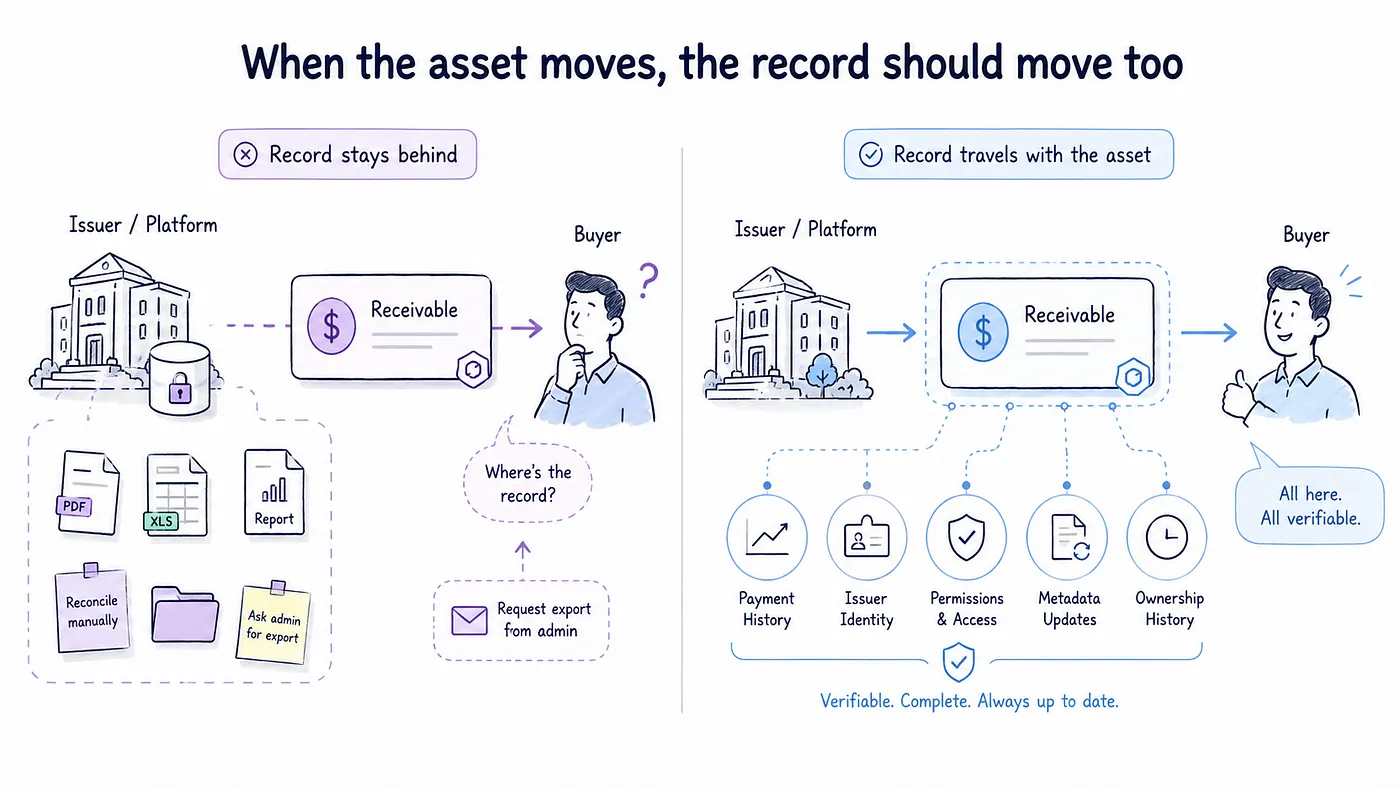
When a receivable or revenue share moves to a secondary buyer or
crosses into another ecosystem, the buyer should be able to check the
payment history, verify who issued the asset, and understand the
current access rules without requesting an export from an
administrator. Uptick keeps that record attached to the asset, so
issuer identity, payment events, metadata updates, and permissioned
changes remain part of the same verifiable history. The context
travels with the transfer rather than staying behind in a private
platform database.
That record matters from the issuer's side too, because a business
that can show a clean, continuous history of distributions, governance
decisions, and ownership transfers has a stronger position when
refinancing, bringing in new investors, or moving across markets, and
the accumulated record becomes part of how the business manages its
own credibility over time rather than simply something buyers check.
The constraint isn't understanding receivables, revenue shares,
recurring distributions, or customer loyalty programs. Businesses
already understand them because those relationships affect cash flow,
reporting obligations, customer retention, and financing decisions
every day. The harder part is translating those relationships into
assets that stay enforceable, transferable, and understandable once
they leave the system where they originated, without creating a new
layer of complexity somewhere else.
Many tokenization efforts stalled at that point. Recording an asset
on-chain is relatively straightforward, but businesses still have to
manage counterparties, compliance requirements, reporting obligations,
and ownership records. If the new system leaves those jobs untouched,
adoption depends on belief in the technology, but when it reduces the
work attached to those jobs, the decision becomes much more practical.
The connection to the real economy is strongest when the asset already
sits inside a commercial process people understand. A receivable,
loyalty asset, ticket, or creator license doesn't need to sound like
capital markets infrastructure to benefit from portable records,
because each one carries rules, rights, usage history, or transfer
conditions that become more valuable when they remain readable after a
transfer.
Invoices and receivables have resisted tokenization for real reasons,
including counterparty fragmentation, credit risk that doesn't
transfer easily across buyers, jurisdiction questions that make
enforceability uncertain across markets, and trade finance incumbents
that already own the relationship. Those aren't perception problems,
but keeping payment logic, rights, and records attached to the asset
makes the evidence around that risk easier to evaluate than when it
has to be rebuilt from disconnected admin reports.

Prestige is still important, and big names and institutional pilots
help outsiders take the category seriously, which is not nothing, but
markets don't become durable because they attract attention. They
become durable when participants start relying on the same processes
repeatedly, certain asset types begin to feel normal, and
infrastructure gets shaped around the work people keep doing. If that
reliance never forms, the market stays weak regardless of how many
headline assets get issued.
Plenty of repetitive business processes have had new infrastructure
layered onto them without adoption sticking, usually because the new
system added work rather than removing it, or required every
counterparty to change behavior at once, and operational familiarity
isn't enough on its own unless the improvement is large enough that
the people doing the work keep choosing the new process after the
novelty disappears.
A business that spends less time chasing late payments because payment
logic is recorded and executed through a clearer process has a genuine
reason to keep using the system, and so does a fund that stops
assembling distribution reports by hand, or a company that stops
rebuilding compliance context every time it enters a new market. None
of those are particularly exciting use cases, but they create the kind
of habitual reliance that prestige assets rarely do.
After a year of distributions, transfers, and reporting cycles, the
practical question is whether a receivable or revenue share running on
the network has become easier to audit, verify, and hand off than the
same asset managed through a fragmented administrator-led process. If
the process friction falls and the record becomes easier to carry
between counterparties, adoption doesn't need a separate narrative to
justify itself.

The strongest RWA infrastructure becomes more valuable as the asset
operates, because each payment, transfer, or lifecycle update adds to
a record that would otherwise have to be pieced together from separate
systems. That value doesn't show up at launch, it shows up the first
time a new buyer can verify the asset's history without asking the
issuer or administrator to recreate it.
The same pressure returns each time the asset reaches a new financing
moment, when a buyer, lender, marketplace, or partner is not simply
checking the asset as it exists today, but whether the record behind
it is complete enough to rely on. If that record has been accumulating
with the asset, the next review starts from the existing record, but
if it has been spread across reports and private systems, every new
opportunity begins with another round of reconstruction.
A tokenized receivable or revenue share on Uptick should carry more
usable evidence at month twelve than it did at issuance, with payment
events recorded, ownership verified, and lifecycle updates preserved
without an administrator assembling them by hand. If the record
becomes easier to check as the asset operates, the second buyer has
more to work with than the first, and the business behind the asset is
not forced to prove the same history from zero every time ownership,
financing, or market access changes.
If the infrastructure doesn't solve that problem, tokenization is only
changing the wrapper around the asset, not the work required to trust
it.