Uptick Energy RWA: Connecting Real-World Energy Assets to a Global Digital Economy
Published on Aug 27, 2026
Energy is emerging as one of the most promising asset categories for the next phase of RWA. When people talk about RWA today, they often think of standardized financial assets such as government bonds and funds. But if RWA is truly going to enter the real economy, there is a much larger market waiting to be unlocked: energy, power generation, energy storage, infrastructure, and the real cash flows they generate.
These assets have one thing in common: they exist in the real world and generate tangible value, but their value has historically been difficult to standardize, transparently record, and efficiently connect with broader capital markets.
This is where Uptick is focusing its efforts.
Uptick is building a comprehensive RWA infrastructure for energy assets, helping real-world energy assets move from the physical world into the digital world, while enabling clearer valuation, more transparent returns, more efficient operations, and, over time, greater potential for asset liquidity.
We have completed the development of our core products and technology ecosystem. Now, we are entering the next stage: working with real-world industry partners to connect these capabilities to actual energy assets and jointly build and validate real-world Energy RWA use cases.
Why Are We Launching RWA Infrastructure for the Energy Sector?
We believe that truly valuable RWA should not simply put an existing financial product on-chain in a different form. What deserves to be digitized are assets that already create real-world value.
Energy assets are a natural example.
A solar power plant generates electricity every day. An energy storage facility participates continuously in the power market. A commercial and industrial battery energy storage system can help businesses reduce their electricity costs. These assets have physical equipment, operational data, real business activities, and recurring cash flows.
The challenge is that these values have traditionally remained within fragmented and highly localized industry systems. An asset owner may operate an energy project worth tens of millions of dollars or more, yet still rely on traditional financing channels. Investors who want to understand how an asset is actually performing may only have access to periodic reports. Calculating and distributing returns can also require significant manual work and reliance on institutional trust.
The problem is not that these assets lack value. The problem is the lack of infrastructure that allows their value to be seen, verified, operated, and eventually made more accessible to capital.
This is why Uptick is focusing on Energy RWA.
We are not trying to make energy assets increasingly complicated through financial engineering. Instead, we want to use digitalization, data infrastructure, and blockchain-based infrastructure to make real energy assets more transparent and standardized, while creating better ways to connect them with capital.
Uptick Is Building an Ecosystem, Not a Single Product
Energy RWA is not simply about putting a power plant on-chain.
From the moment an energy asset enters a platform to the point where it generates returns and potentially becomes an investable or transferable asset, a complete set of questions needs to be answered:
Where does the asset come from? Is the data reliable? How are returns generated? How can those returns be improved? How should they be distributed? How can the asset be represented in a standardized form? And eventually, how can it connect with investors and capital markets?
That is why Uptick is building a complete Energy RWA ecosystem rather than a single standalone product.
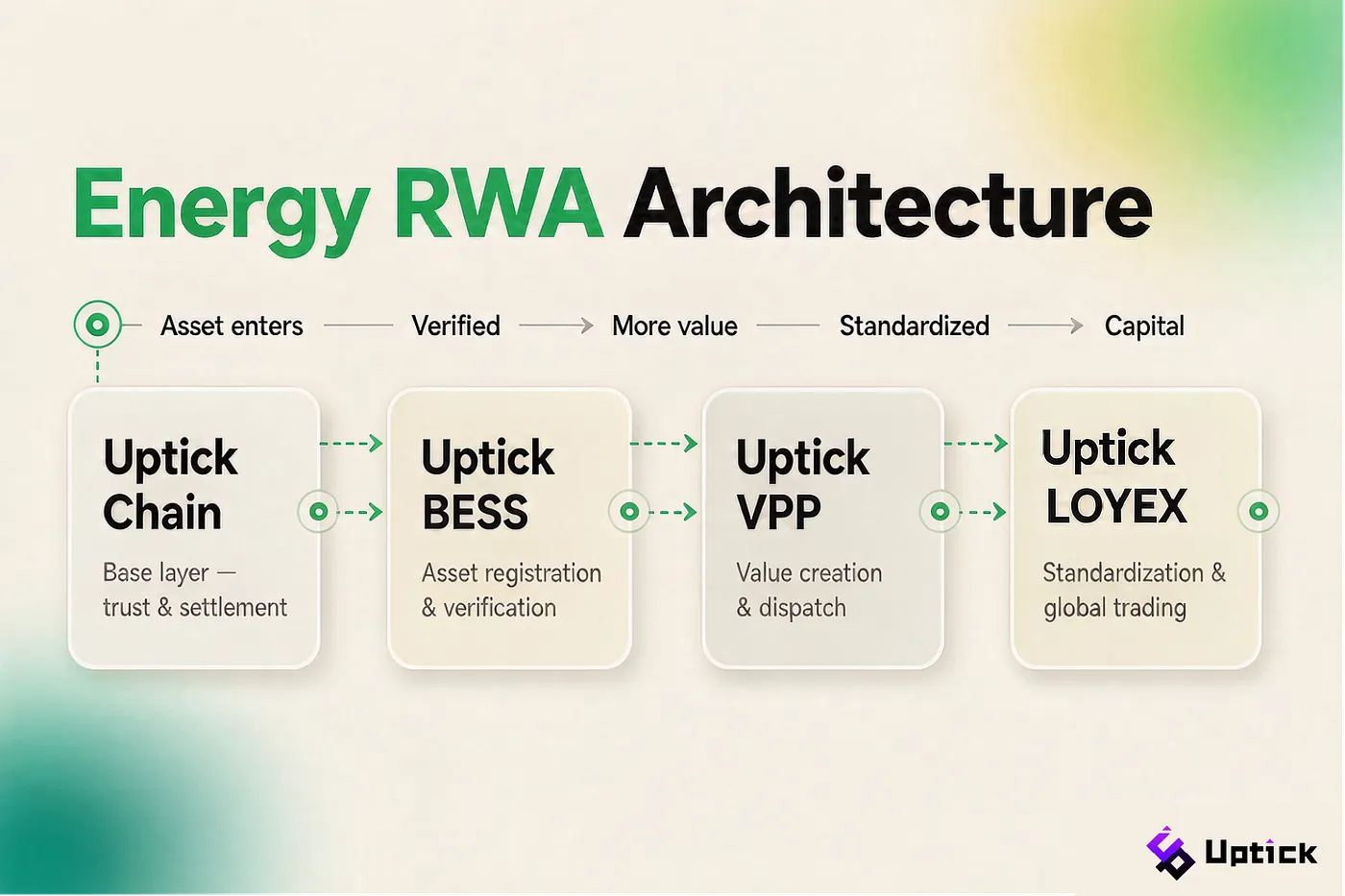
Today, our energy-focused architecture consists of four core components:
- Uptick Chain — the underlying trust and settlement infrastructure for Energy RWA;
- Uptick BESS — connecting energy storage assets with asset registration, data verification, yield measurement, settlement, and assetization capabilities;
- Uptick VPP — aggregating distributed energy storage and using intelligent dispatch to unlock more efficient operating returns;
- LOYEX — providing infrastructure for RWA asset standardization and issuance, with a long-term vision for global trading and liquidity.
These are not isolated products. They correspond to different stages of the energy asset lifecycle. Put simply:
BESS makes assets visible and verifiable. VPP helps assets generate more value. RWA infrastructure gives assets a standardized digital representation. LOYEX creates the potential for those assets to eventually reach broader markets.
This is the core of Uptick’s Energy RWA strategy.
Step One: Making Energy Assets Trustworthy and Verifiable
The first step in Energy RWA is not issuing a token. It is answering one fundamental question: Is the asset represented on-chain actually real?
For energy assets, the answer must ultimately come from real operational data. Take energy storage as an example.
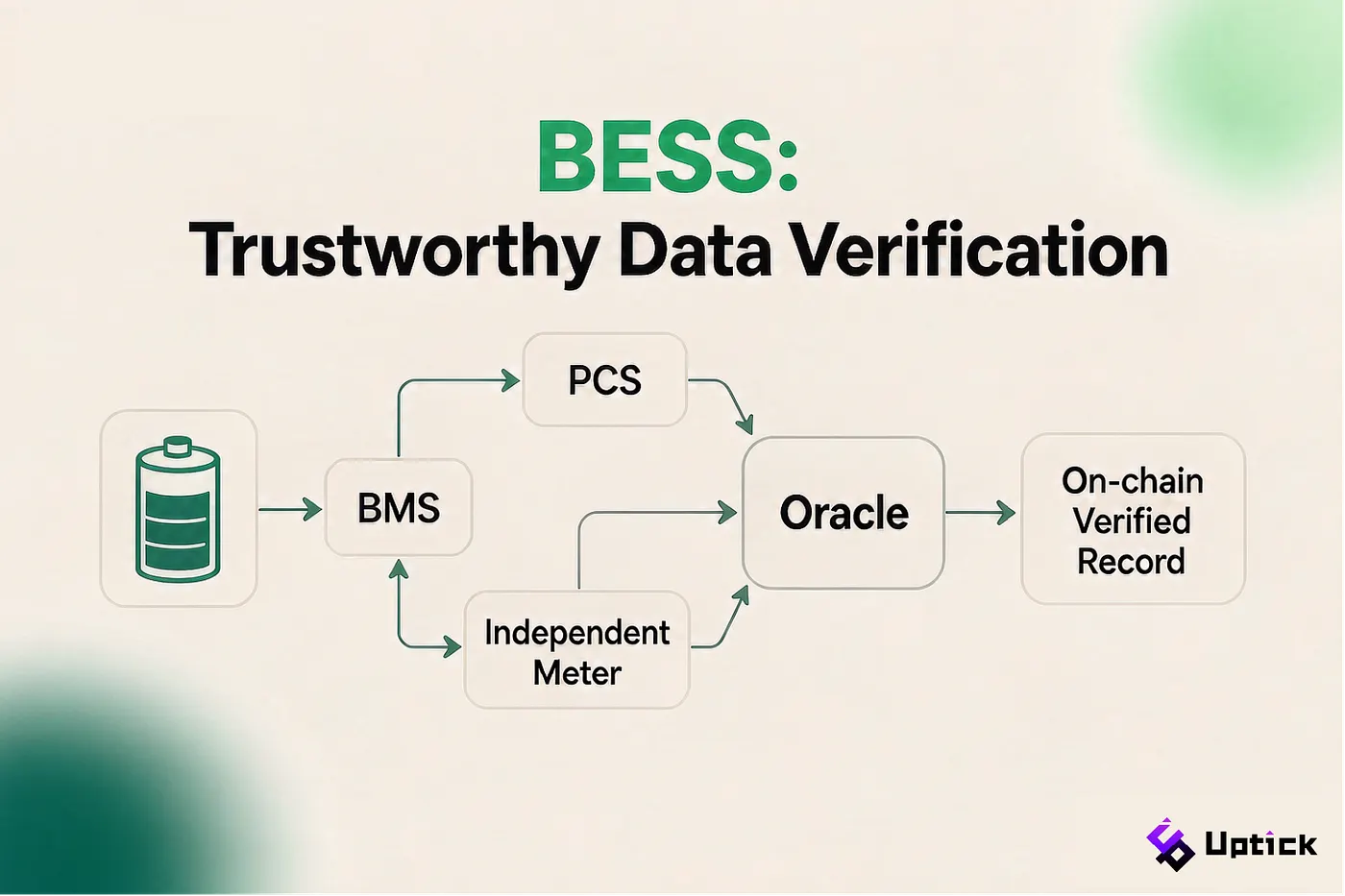
Uptick BESS can connect to multiple data sources, including BMS, PCS, and independent meters, to collect and verify equipment status, charging and discharging activity, and operating returns. Verified data can then be recorded on-chain through oracle mechanisms.
This means that on-chain figures are no longer simply manually entered reports. They can be linked back to the actual operation of physical assets.
On top of this foundation, asset registration, yield measurement, settlement, distribution, and redemption can gradually become standardized digital processes.
This is fundamentally about solving the trust problem.
For asset owners, their physical assets and operating data can be represented in a more standardized digital format. For potential investors and ecosystem partners, this creates a more transparent and traceable view of the underlying assets.
The value of RWA is not simply turning an asset into a number. It is making sure that the number can always be traced back to something real in the physical world.
Step Two: Turning Energy Storage from Equipment into a Productive Asset
Trust is only the beginning. For energy assets, an even more important question is: Can the asset continuously generate better returns?
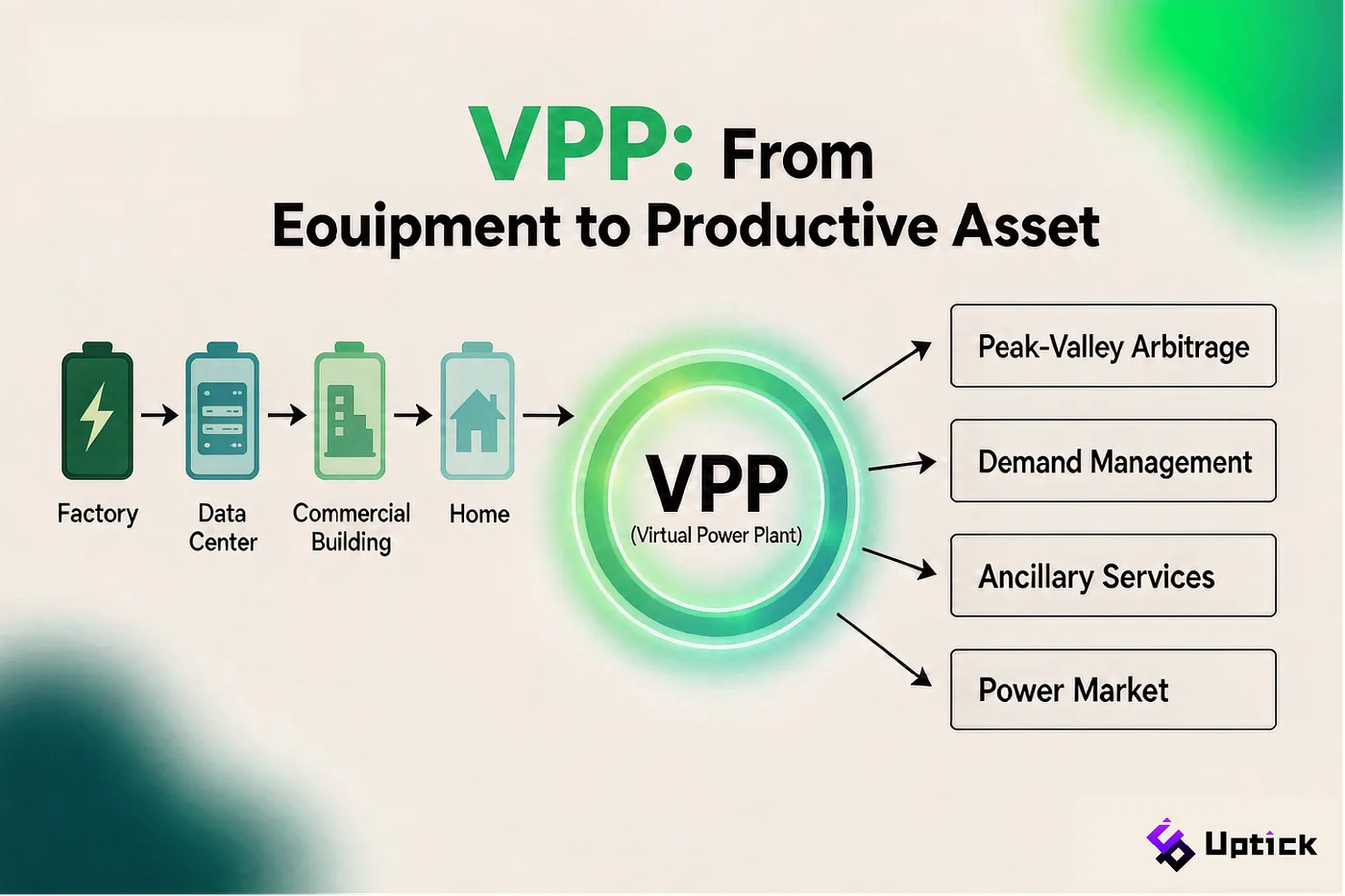
This is where Uptick VPP comes in. Today, energy storage systems are already deployed across factories, industrial parks, data centers, commercial properties, and households. Yet many systems still perform only basic functions such as peak-valley arbitrage or backup power. In reality, a battery can potentially create value far beyond these basic functions.
By aggregating distributed energy storage through a Virtual Power Plant, and combining it with forecasting, intelligent dispatch, and market strategies, energy storage resources can potentially participate in multiple revenue streams, including peak-valley arbitrage, demand management, ancillary services, and other power-market opportunities.
In simple terms:
BESS answers “What is the asset? What is the data? How much return does it generate?”VPP answers “How can this asset generate more value?”
This is particularly important for the future of RWA. An asset that continuously generates real cash flow provides a much stronger foundation for assetization and eventual capital connectivity.
That is why Uptick does not view Energy RWA simply as an “asset registration system.” We want to participate in the value-creation process starting from asset operations themselves.
Step Three: Giving Real Assets a Standardized Digital Representation and the Potential for Liquidity
Once an asset can be reliably recorded and continuously generate returns, the next step is to standardize its representation and explore its connection with capital.
This is where Uptick’s RWA infrastructure and LOYEX come into play.
Through RWA infrastructure, real energy assets, asset interests, and associated returns can be represented in standardized digital forms. Depending on the regulatory requirements of different jurisdictions, appropriate mechanisms can then be designed for issuance, holding, distribution, and redemption.
LOYEX is exploring the next layer: building infrastructure for the issuance and trading of real-world assets, with the long-term goal of giving assets that are currently fragmented across regional markets, traditional contracts, and OTC channels a more standardized market representation.
There is, however, one important principle we want to make clear:
We do not assume that every energy asset can simply be offered for trading to global investors today.
Different jurisdictions have different requirements regarding asset securitization, investor eligibility, cross-border capital flows, and digital assets.
Therefore, the journey from a “real asset” to an asset that can be publicly issued and traded still requires asset screening, legal structuring, compliance review, investor suitability, and adaptation to the regulatory environment of each market.
Uptick’s role is to provide the infrastructure and capabilities needed to support this process — not to bypass it.
The long-term pathway can be understood as:
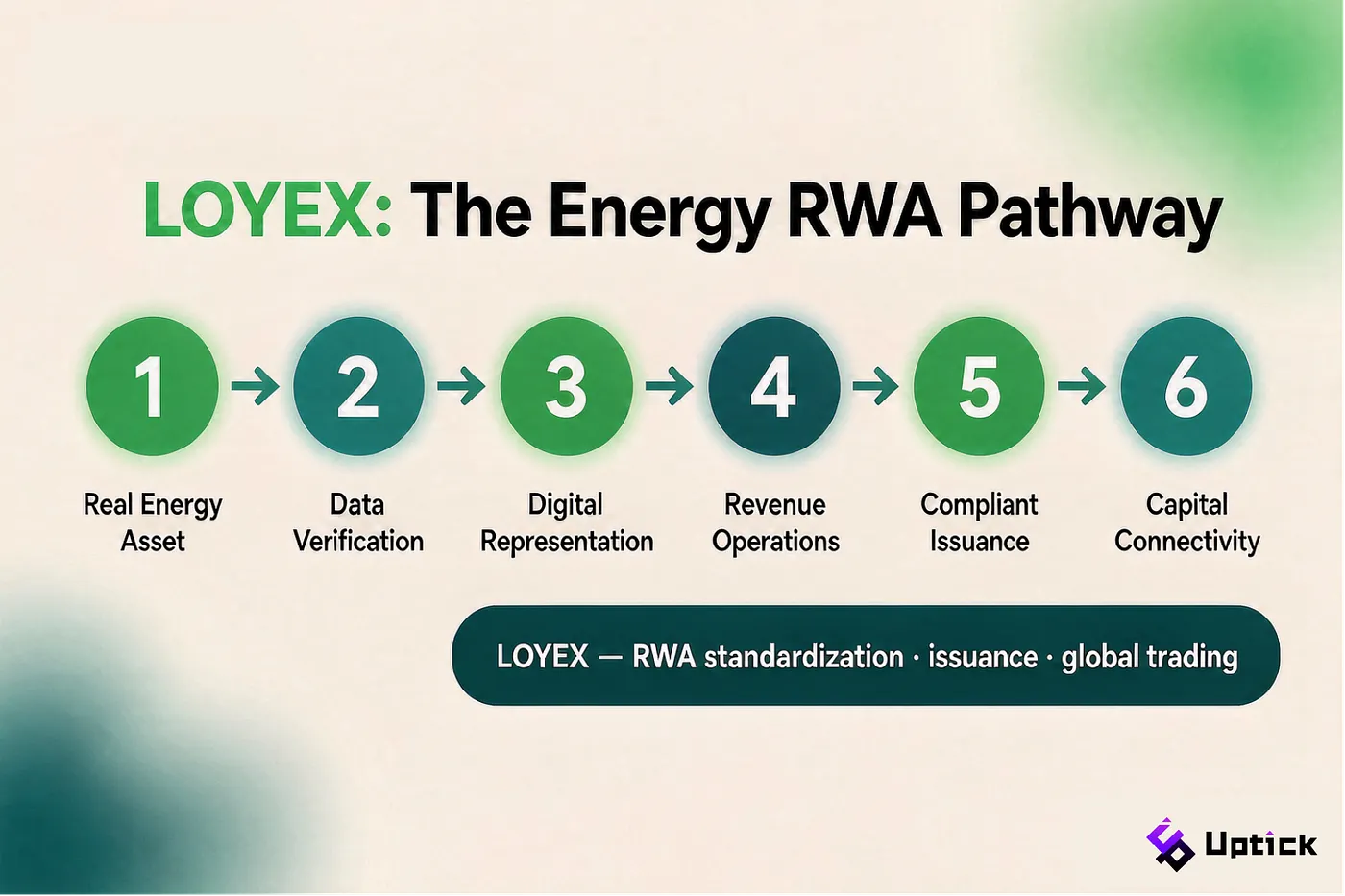
Real Energy Asset → Data Verification → Digital Representation → Revenue Operations → Compliant Issuance → Capital Connectivity
Where Are We Today?
This is an area where we want to be particularly transparent with the market.
Uptick’s Energy RWA ecosystem has now reached the stage where its core products and infrastructure are in place. Our next focus is ecosystem deployment and the development of real-world pilot cases.
Uptick Chain, BESS, VPP, RWA asset management, and LOYEX have established their respective core capabilities, while product refinement, system validation, and scenario testing continue.
This means we have moved beyond simply asking, “How should Energy RWA work?”
We are now entering the stage of using real-world assets to validate how this ecosystem can work in practice.
The most important next step is not to build another impressive demo or add more concepts. It is to find partners who actually own energy assets and operate real energy businesses.
We are looking to work with, among others:
- Owners of commercial and industrial, residential, or large-scale energy storage projects;
- Solar and wind energy project developers;
- Energy storage equipment manufacturers and EPC companies;
- Power companies, energy aggregators, and VPP operators;
- Energy data, IoT, and intelligent energy management providers;
- RWA, financial, compliance, distribution, and capital market partners.
Together with these partners, we want to connect real assets to the platform, verify their data, optimize their operating returns, build real operational records, and then explore the next steps toward assetization and capital connectivity.
For Uptick at this stage, the most important keywords are not scale, but: Real Assets. Real Business. Real Validation.
We would rather start honestly with the first real cases than use concepts to create the impression of achievements that have not yet happened.
Building the Energy RWA Ecosystem Together
Our vision for Energy RWA has never been simply about “putting energy assets on a blockchain.”
What we want to build is a complete value chain: Make assets visible. Make data verifiable. Help physical assets generate sustainable cash flow. Give those assets standardized digital representations. And, within appropriate regulatory frameworks, gradually connect them with broader sources of capital.
Uptick has already built the core infrastructure needed to support this journey.
Now, we are looking for industry partners to build it with us. We welcome you to work with Uptick and explore what we can build together.