Web3 Infra Series | The Confidence Layer Missing From Tokenized Asset
Markets
Published on May 27, 2026
One of the strangest things about the RWA market is how often people
conflate transferability with liquidity. They're not the same thing,
and the gap between them is where most of this space is currently
stuck.
You can tokenize an asset, put it on-chain, make it technically
movable between wallets, list it somewhere that has the visual grammar
of a market, and still end up with nothing that resembles actual
trading. Secondary demand doesn't follow from transferability, and it
never has.
The assumption underlying most RWA launches is that once the token
exists, the liquidity problem becomes a distribution problem. Get
enough people to see it and trading follows, but that framing is wrong
in a specific way. It treats the first buyer's due diligence as a sunk
cost rather than a recurring one, so every new buyer has to rebuild
confidence in the asset more or less from scratch, and if the
information needed to do that is spread out, expensive to verify, or
just absent, most of them won't bother.
This results in the token just sitting there, and the market staying
thin, and that's not a token design problem, it's a legibility
problem, which compounds the longer it goes unaddressed.
What Uptick is building, even when it isn't framed this way
explicitly, is that on-chain records, readable payment history, and
traceable governance do something specific for secondary market
formation. They make the asset cheaper to understand for each
successive buyer, which is different from making it easier to
transfer, and that's what actually matters for liquidity, because it
lowers the cost of the confidence-building every buyer has to do
before they step in.
In this article we're going to explore why legibility is the missing
layer in most RWA deployments, and how Uptick's infrastructure
approach is aiming to solve it.
The market still gives too much credit to movement.
If a token can be transferred, bridged, listed, or made technically
available across systems, that gets treated as progress toward
liquidity, but it's really just progress toward tradability, and those
are not the same thing.
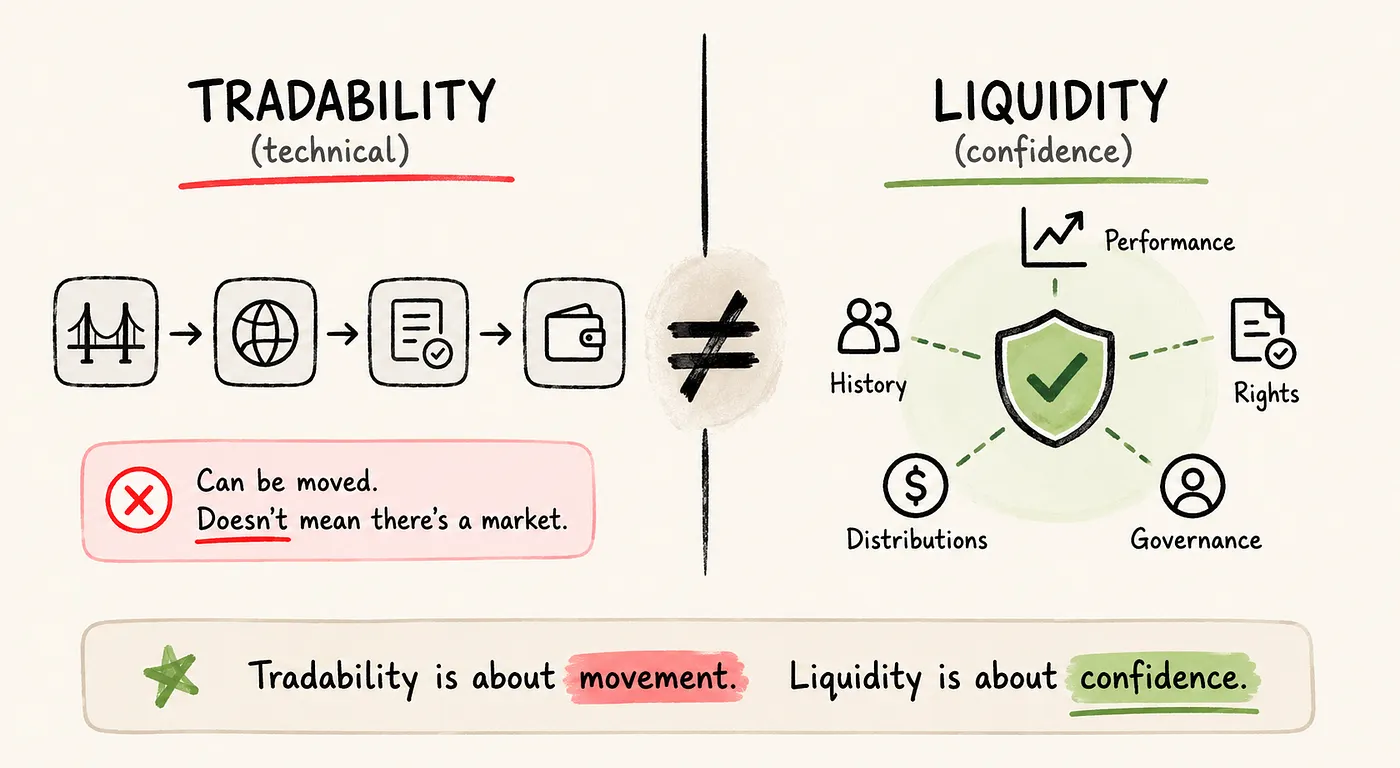
Tradability is a technical condition and liquidity is a confidence
condition, and most of the infrastructure being built right now is
solving for the first one and assuming the second will follow.
A buyer looking at a tokenized asset in a secondary market isn't
simply asking whether the token can be received and held, they want to
know how the asset has behaved, how value has moved through it, how
decisions have been made, whether rights are clear, whether
distributions have been reliable, and whether the whole thing still
makes sense without leaning too heavily on whoever is selling it.
That is a completely different burden from transferability, and it's
the one that actually determines whether a market feels real.
This is why so many tokenized assets still don't feel truly liquid,
because the transfer layer has improved considerably, but the
confidence layer is still too weak, and if every new buyer has to
rebuild the whole case from scratch, the market stays narrow. There
could be a few informed holders and occasional trades between a
handful of participants, but that's not a secondary market with any
real depth.
Most business owners understand this instinctively, which is why a
product isn't easier to sell just because it can be shipped, and a
business isn't easier to finance just because the legal paperwork
exists, because in both cases the buyer still has to feel confident
enough to move.
Tokenized assets work the same way, and the ability to transfer is
necessary but nowhere near sufficient.
This is one of the clearest reasons liquidity stays thinner than
people expect.
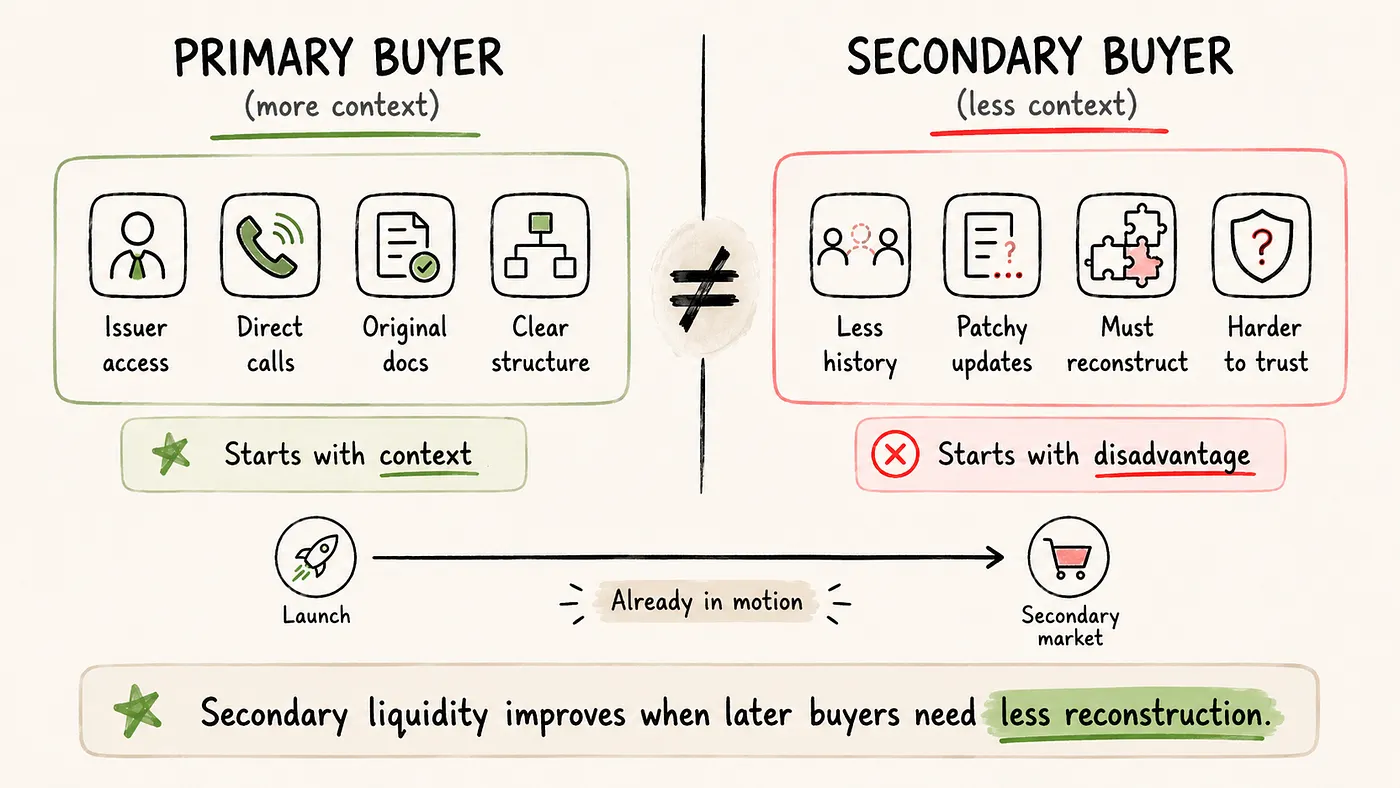
The first buyer often knows the issuer better, may have been closer to
the initial raise, and likely had direct conversations, custom
documents, and a cleaner understanding of how the asset was structured
from the start, but the second buyer usually gets much less than that,
and it changes the economics of trust immediately.
A secondary buyer is stepping into something already in motion, so
they need to understand not just what the asset is but what has
happened since launch, whether distributions kept arriving, whether
governance has been stable, whether the asset has behaved as expected,
and whether there have been material changes or signs that the whole
thing has become harder to read over time.
If that record is weak, secondary demand weakens with it.
This is one reason the old idea about tokenization creating liquidity
has always felt too loose. Tokenization creates the possibility of a
transfer, and secondary liquidity only starts becoming real when later
buyers can enter with less informational disadvantage than they would
have had in a traditional structure. If they still need to do
significant reconstruction, the asset stays technically tradable but
feels commercially heavy.
That's exactly where Uptick's RWA 2.0 infrastructure makes a more
concrete argument than most of what's circulating in this space.
First-generation tokenized assets ignored provenance and track record,
which produced tokens that functioned technically but failed to
attract secondary market depth because investors couldn't verify
performance independently.
Uptick's approach treats on-chain history as a core component of asset
value rather than a byproduct of it, handling continuous
tamper-resistant performance records, portable compliance credentials
that reduce the need to keep rebuilding verification context,
automated on-chain distribution records, and transparent governance
trails. Each passing cycle adds to that record, and that accumulation
is what makes the asset cheaper to evaluate for each successive buyer,
because more of the information needed to build confidence is already
attached to the asset, rather than needing to be reconstructed from
square one.
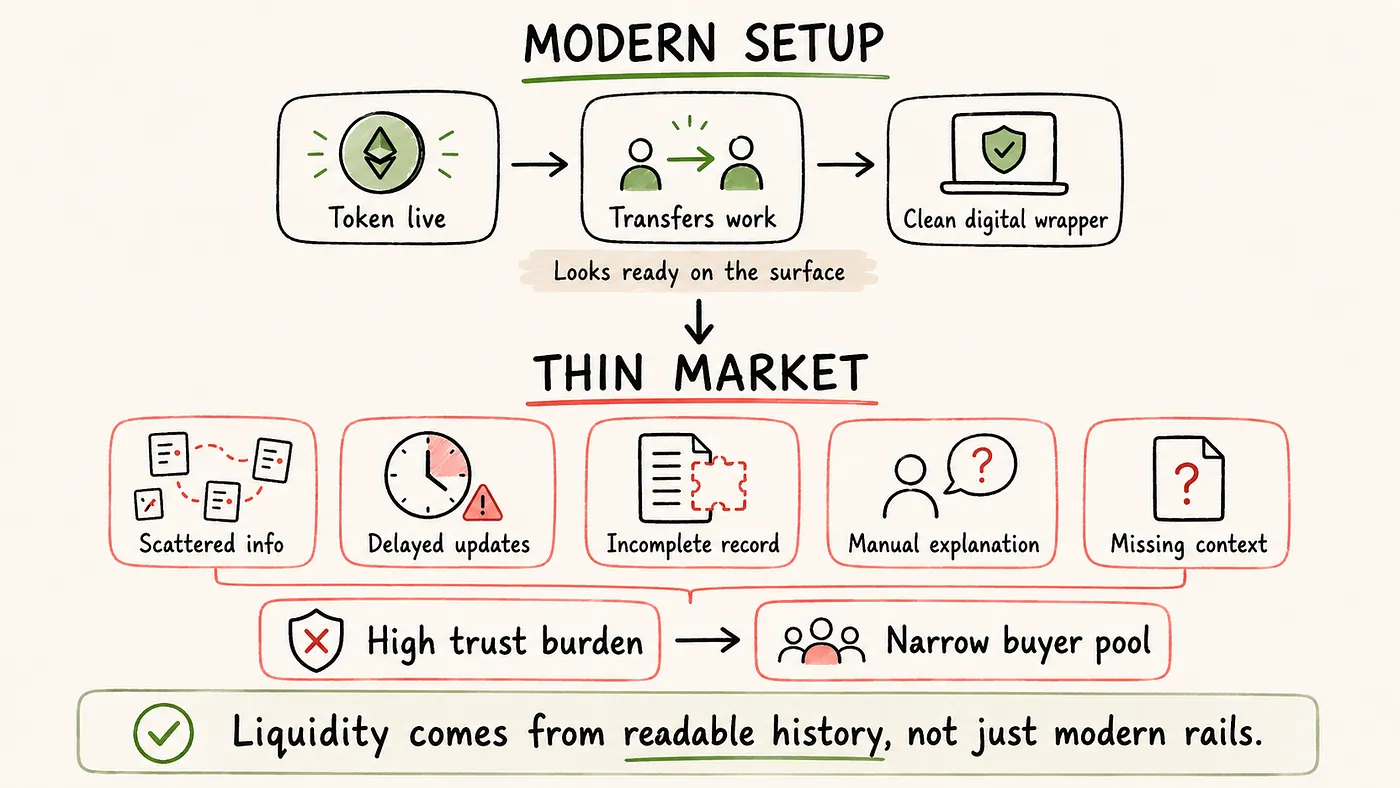
The market starts feeling thin here even when the infrastructure looks
modern.
A later buyer shouldn't need to trust the issuer's presentation more
than the asset's own record, and that's the point most tokenized
assets still haven't reached. The token may be live, the transfer
logic may work, the asset may sit in a digital form that looks clean
enough on the surface, but if the surrounding information is
disconnected, delayed, incomplete, or too dependent on manual
explanation, the buyer is still being asked to extend a level of trust
that most won't.
It shows up in familiar ways. Trust that distributions happened as
described, that the operational record is complete, that performance
updates reflect the full picture, that governance was sound, that no
important context is missing, that the asset remains structurally
healthy even if the reporting doesn't make that obvious. Each one of
those is a gap the buyer has to bridge on their own, and when enough
of them stack up, later buyers start stepping back, not always because
the asset is weak, but because the informational burden is too high
relative to the benefit of entering.
If the market asks a buyer to do too much interpretation, the asset
starts feeling less like a market instrument and more like a private
arrangement with a token attached to it. A liquid market doesn't
eliminate trust, it reduces the amount of blind trust required, and it
does that through visibility, continuity, and enough readable
operating history that later participants can enter without being
forced into a highly asymmetric position.
Once the cost of confidence stays high, the market stays narrow
regardless of how often people say the word liquidity.
The easy mistake is to think the market mainly needs more venues, more
integrations, more access points, or more chains.
Sometimes it does, but quite often it needs something less exciting,
like a better record. A later buyer wants to know what the asset has
done, not just that it exists. Whether payments flowed consistently,
distributions arrived on time, counterparties remained stable,
governance decisions were visible, and the asset was managed in a way
that builds confidence rather than eroding it. If something went
wrong, was it visible. If expectations changed, was that recorded
clearly. If the asset has moved across systems, did the history travel
with it in a form that still makes sense. That's what gives a
secondary market something to stand on.
Without that layer, buyers remain too dependent on packaging, and
they're not reading an asset, they're reading somebody's current
explanation of the asset, which is much weaker ground.
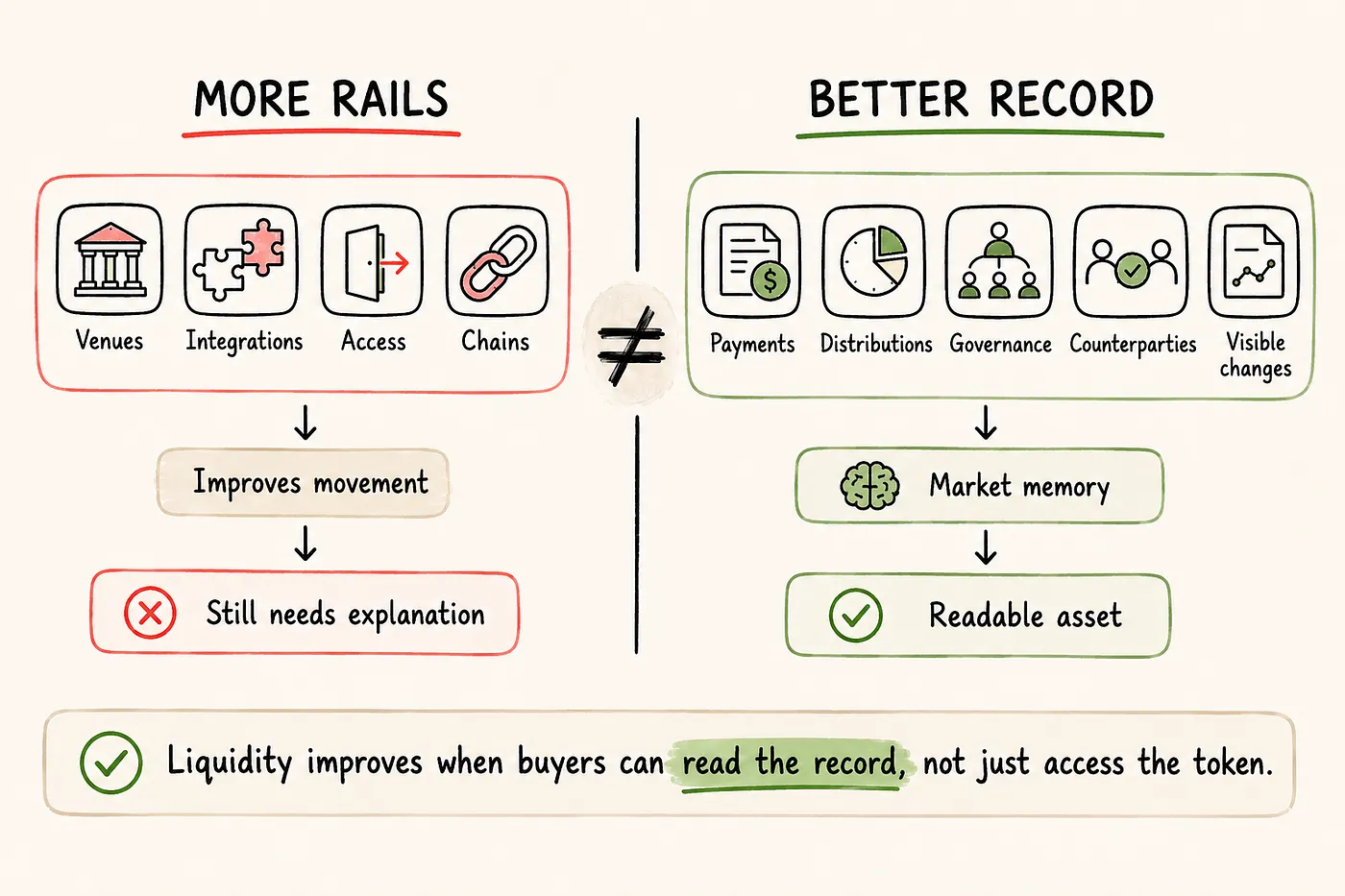
This is where the stronger RWA infrastructure picture becomes more
interesting than the basic concept of tokenization. A token by itself
doesn't create a market memory, and market memory comes from an
operating trail that is visible enough, durable enough, and coherent
enough to reduce the amount of re-explanation needed each time a new
buyer appears.
Uptick's broader stack starts making a lot more sense for the same
reason.
When you have decentralized data services, omnichannel payments,
governance records, DID-linked access logic, and cross-chain movement,
they are only important if they help preserve the readability of the
asset as it moves through time and across environments. If that
readability stays weak, the transfer layer may improve but the market
still feels thin, and if it improves, the asset starts feeling less
issuer-dependent and more market-readable, which is a much stronger
basis for liquidity than saying the asset is now tradable.
A lot of secondary market confidence gets built through payments.
The market still tends to treat this as an administrative layer rather
than as evidence, which is where a lot of value gets left behind. For
a buyer entering later, payment history is one of the clearest signals
available. Whether investors received what they were supposed to
receive, whether distributions arrived cleanly, whether fund flows
behaved as described, whether the asset kept doing what the structure
said it would do. Those questions matter because they collapse a lot
of ambiguity into something concrete.
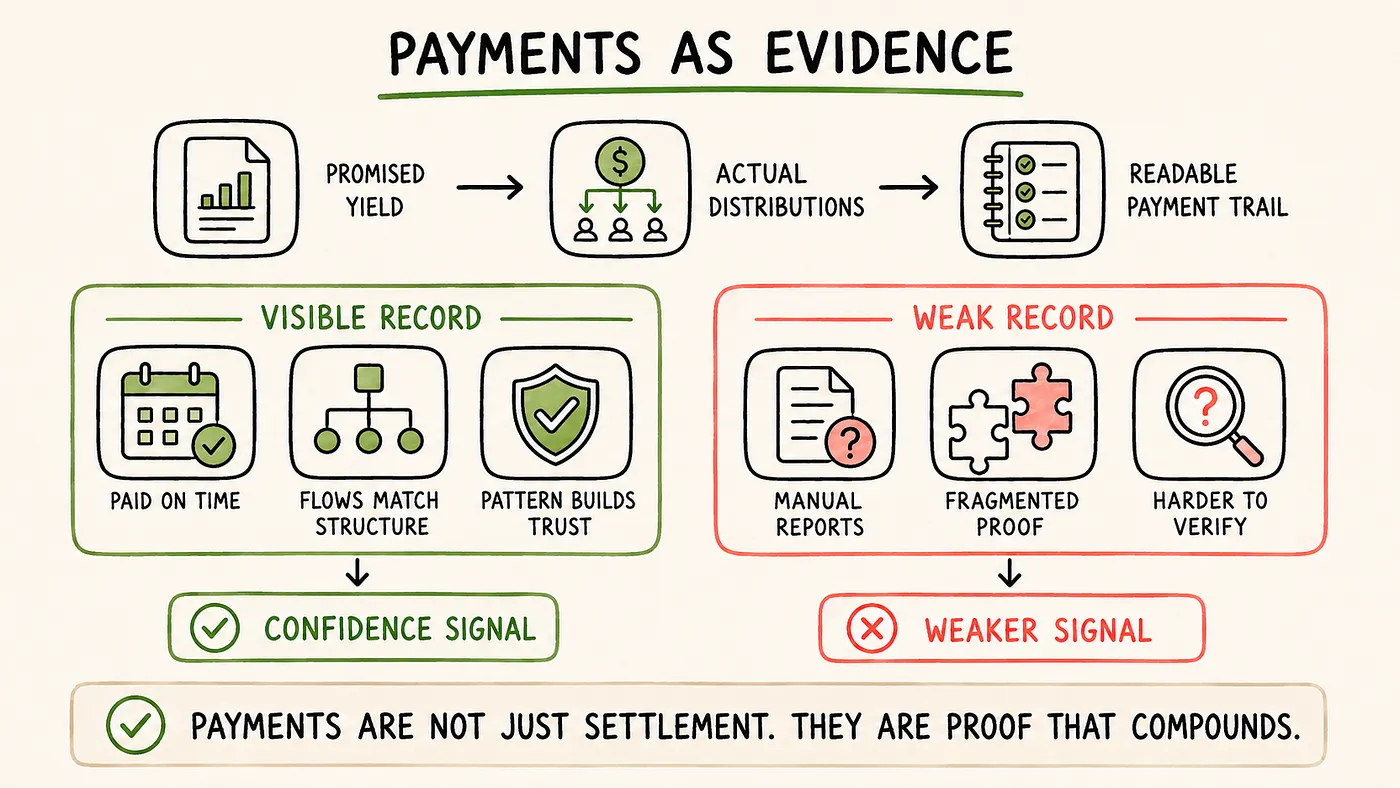
A promised yield is one thing and a visible distribution record is
something else, because the latter does much more work in a secondary
market by turning a claim into a pattern. A projected return is easy
to present, a readable payment trail is harder to fake, and that
asymmetry is exactly why it matters more to a buyer who wasn't there
at the start.
Tokenized assets still struggle for exactly this reason when payment
logic isn't tightly tied into the asset's readable history. If
payments happen but the record stays fragmented, delayed, or dependent
on separate manual reporting, the market can't use them properly as
trust signals. The value is there but the evidence remains weaker than
it should be.
Payments are not simply operational outputs, they're part of the
asset's record, and once that record becomes more visible and more
durable the market has something stronger to work with. That is really
important for later financing, later buyers, and later confidence.
It's not only about settlement, it's proof that compounds, and that's
considerably more valuable than the market currently treats it.

The market likes to talk about cross-chain access as if broader reach
automatically helps liquidity.
Sometimes it does, but often it only shifts the problem around. If an
asset can move into another ecosystem but the buyer on the other side
still has to rebuild confidence from scratch, the extra reach does
less than people hope. The token travelled, but the market confidence
didn't, and that's a distinction the market consistently underweights.
A business owner sees broader distribution, a buyer still sees an
asset that needs too much reconstruction, and the market becomes
technically wider without becoming materially deeper.
A stronger model is one where the record travels with the asset.
Later buyers, even in new markets or new environments, should be able
to understand what they are buying, as opposed to just seeing a
transferable ownership marker. That means carrying the relevant
payment history, entitlement logic, governance trail, and
identity-linked eligibility where it is most important, and these are
the details that make an asset easier to evaluate, rather than just
easier to list somewhere else.
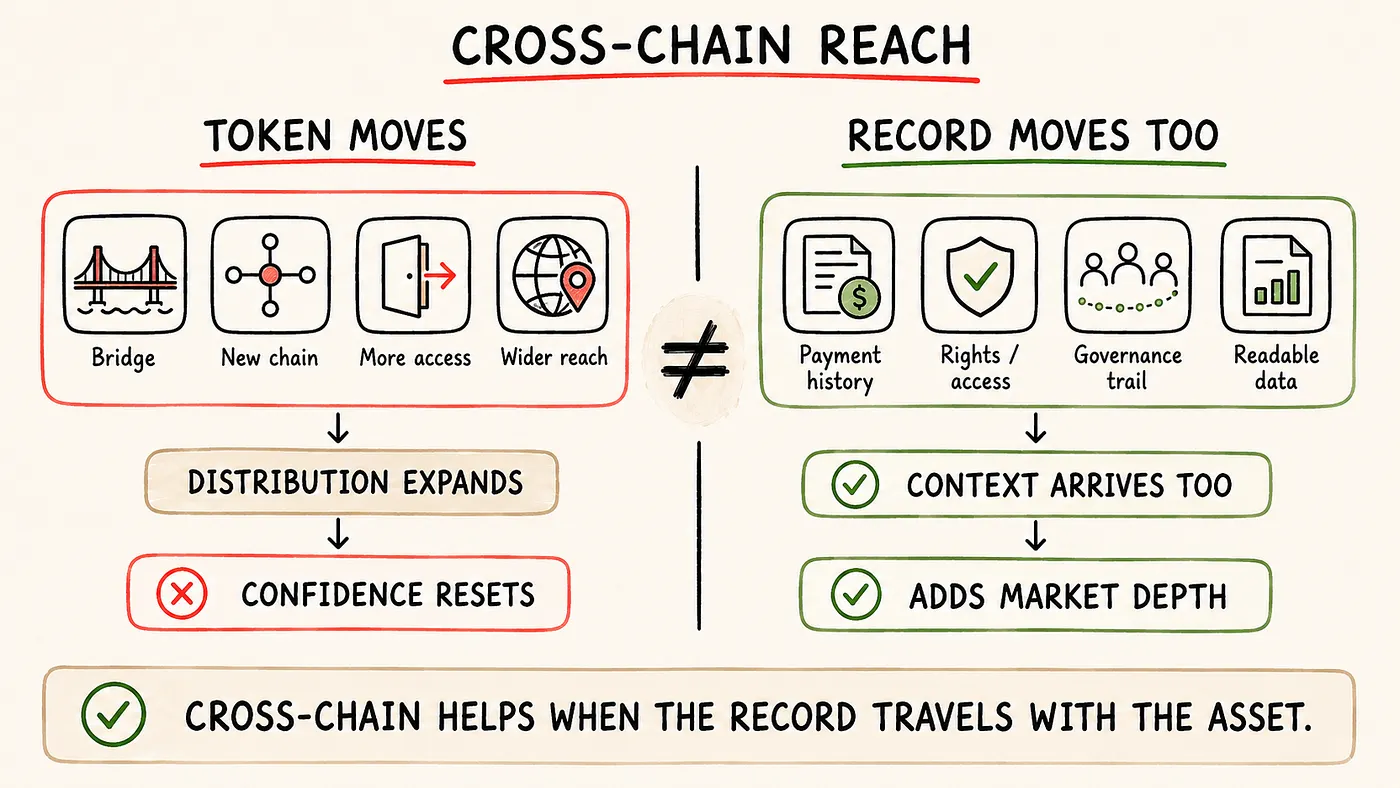
Uptick's cross-chain architecture makes a more specific argument than
standard multi-chain positioning. UCB and IBC handle the movement, but
the commercially meaningful part is whether decentralized data
services, DID-linked access logic, and payment records move with the
asset in a form that still makes sense on the other side.
These are the pieces that make Uptick's roadmap more interesting than
standard cross-chain positioning, because the real question is whether
an asset that originated in one environment can arrive somewhere new
without destroying the operating history that makes it readable.
If it can, every new environment the asset reaches becomes additive to
market depth rather than another place where confidence has to be
rebuilt from nothing, and that's where cross-chain starts becoming a
market-strengthening layer rather than just a distribution play.
A market starts feeling liquid when later participants are no longer
forced into a weak informational position.
The logic from there is fairly straightforward, because the more
readable the asset becomes, the less expensive confidence becomes, and
the less expensive confidence becomes, the wider the buyer pool gets.
That's what deepens a market, not perfectly, not instantly, but
structurally.
This is why so many tokenized assets still don't feel liquid even
though the rails keep improving. The informational disadvantage for
later buyers is still too high, the market still asks for too much
blind trust, too much reconstruction, and too much dependence on
whoever already controls the context, and that problem doesn't get
solved by adding more transfer infrastructure on top of it.
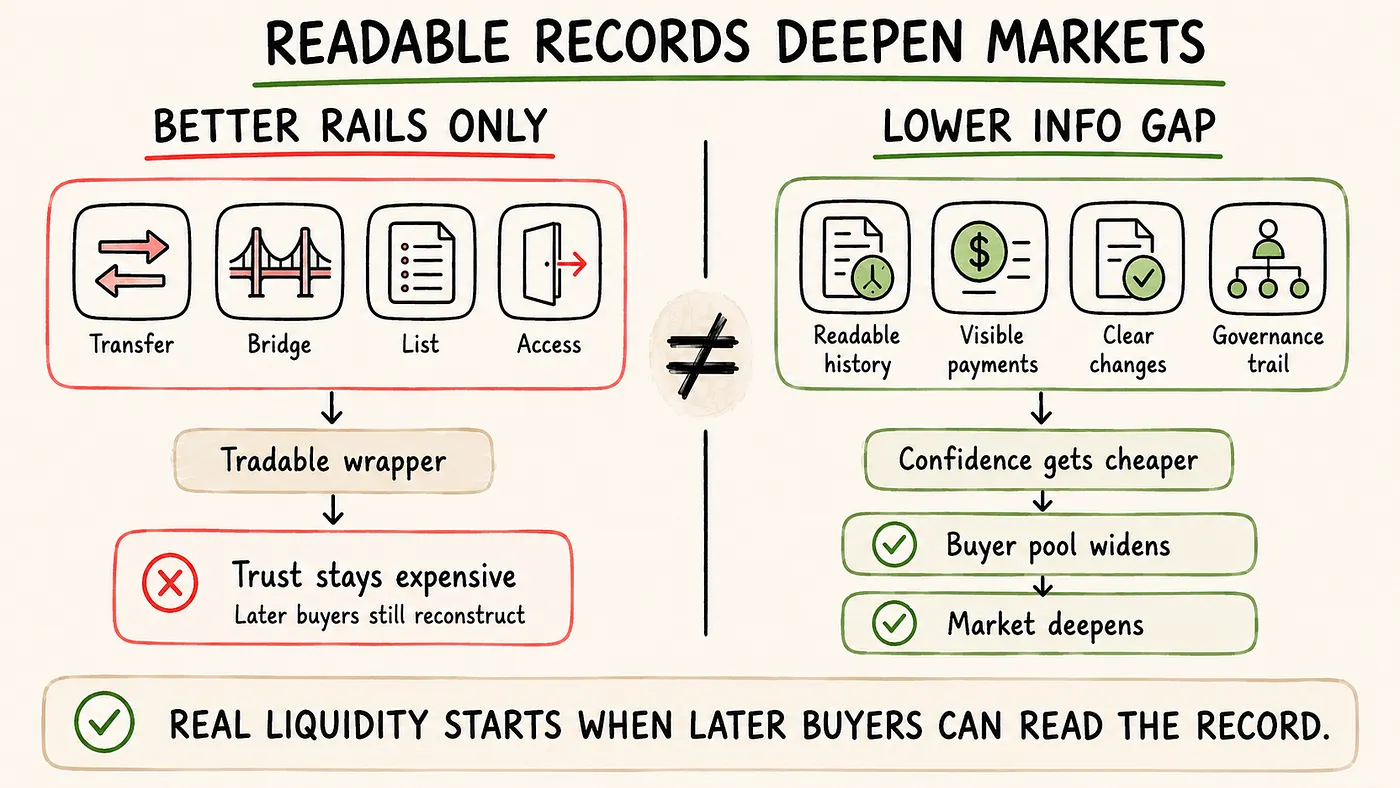
The secondary market question matters because it forces the whole
category to stop admiring the wrapper and start judging the record,
and it forces the market to ask whether this asset has become easier
to understand over time or whether it still needs too much explanation
to sustain broader participation.
That's a better question than whether it's tradable, because real
liquidity is what happens when later buyers stop feeling like
outsiders to the truth of the asset.

Most tokenized assets still don't feel liquid for a simple reason, and
it isn't the transfer layer, which has improved considerably. The
problem is that confidence hasn't kept pace with transferability. An
asset can move, but if the history is fragmented, payments are hard to
read, governance is opaque, and the asset still depends on issuer
explanation more than market-readable evidence, later buyers can't
step in with real conviction, and the market stays thinner than people
expected.
Secondary markets aren't built on tradability alone. They're built on
readable history, visible operating behaviour, and a lower cost of
confidence for the buyer who comes later. That's a harder standard
than most of the category is currently meeting, and it's the one that
actually determines whether a market develops depth or just the
appearance of it.
Liquidity has always been an information problem rather than an
infrastructural one, and the category has spent most of its energy on
the wrong layer. Uptick's bet is that the assets which eventually
develop real secondary market depth will be the ones where the record
accumulated cleanly over time, where each cycle added to what the next
buyer could read rather than adding to what they had to reconstruct,
and where the infrastructure underneath made that possible without the
issuer having to manually hold it together.
That is a completely different kind of infrastructure goal than most
of the category has been chasing, but it's the right one.