Uptick Chain in Brief: The Foundation a Chain Needs to Hold Real Assets
Published on Oct 21, 2026
Every public chain competes on the same scoreboard — TPS, ecosystem size, gas fees. But put a solar farm, a batch of receivables or an institution’s membership on-chain, and the exam changes: finality, accountability, settlement dependency. Uptick Chain’s three-stack architecture, account abstraction, compliant identity and four-track stablecoins are the foundation built around those three questions.
For years the public-chain narrative has been stuck on the same scoreboard: who has the higher TPS, the bigger ecosystem, the cheaper gas.
Those metrics suit a chain built for trading coins and playing with NFTs. But change one premise — you want to put a solar plant, a batch of receivables, or an institution’s membership system on-chain — and they stop being enough almost immediately.
Because real assets don’t care how many transactions you can process per second. They care about three other things:
- Could this title of ownership be rolled back?
- When something goes wrong, who is accountable, and how do we trace it?
- Is my asset’s throat being held by somebody else’s pipe?
Those three questions are the real exam for infrastructure. Most of Uptick Chain’s design choices trace back to them.
1. A Different Exam: What Real Assets Care About
Start with the first: finality.
Most EVM chains offer probabilistic confirmation — you see twelve blocks and finally breathe out. But when you’re settling an asset on-chain, “it probably won’t be rolled back” is not acceptable. For an auditor, “settled, but the ledger was reorged” is a catastrophe, because it means the books no longer match the asset itself — and reconciliation is exactly where RWA cannot afford to be wrong.
Uptick Chain uses CometBFT’s BFT proof-of-stake consensus: single-block instant finality, no reorgs. In the project’s own words, this is “the most RWA-audit-friendly property there is.” Block time is 6–8 seconds, and that cadence is deliberate: metering data for energy and compute assets already updates on a minute-level rhythm. Being ten times faster buys nothing, while being slower than a minute distorts the data.
The second question is accountability. Real assets have people behind them: issuers, custodians, auditors, regulators in a specific jurisdiction. If a chain offers nothing but “transfers between anonymous addresses,” every one of those roles disappears on-chain, and compliance becomes a conversation you can’t even start.
The third is settlement dependency. This one gets ignored the most, and it bites the hardest: if your stablecoin arrives over some bridge, and that bridge has a bad day, your asset settlement is left hanging in the air with it.
Peace of mind about an asset depends on whether you control its settlement dependency. That sentence is where this entire infrastructure design starts.
2. Three Stacks in Parallel: Why Not Pure EVM, Why Not Pure Cosmos
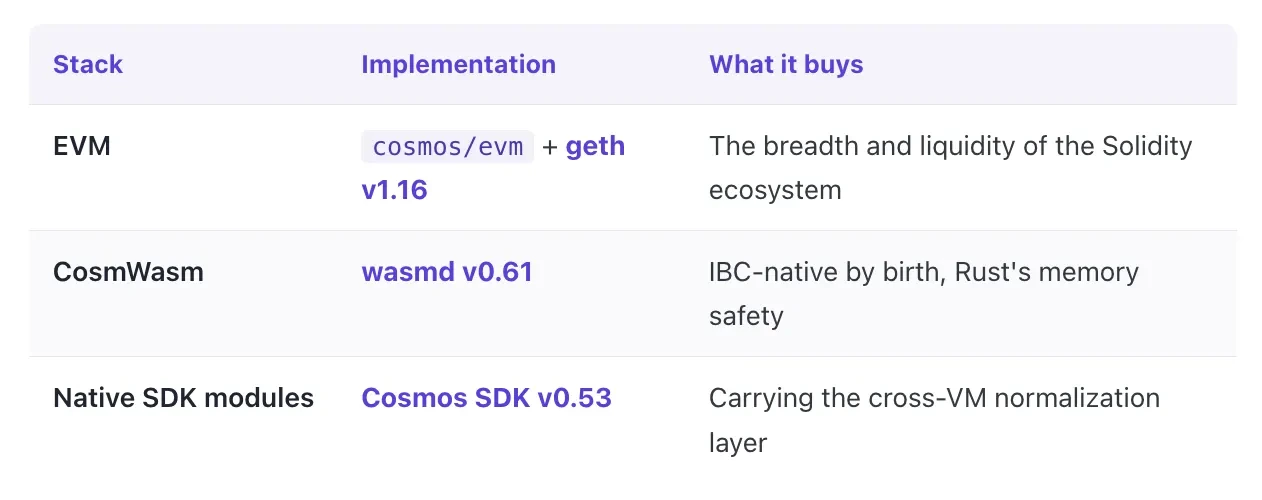
Uptick Chain’s architectural choice is unusual in the Cosmos world: three stacks running side by side on the same state machine.
Press enter or click to view image in full size
Wouldn’t a single stack be simpler? Yes — and it would also lose things.
A pure EVM chain can’t get IBC’s native interoperability; cross-chain work has to go through bridges. A pure CosmWasm chain can’t absorb the existing contracts, tooling and developers of the Solidity world. For a chain meant to carry real assets, neither can be abandoned: EVM faces the outside world, CosmWasm handles cross-chain movement and asset primitives, and native modules tie the two together.
But dual-VM has a well-known trap: it tends to slowly collapse back into a single VM. Developers all write on the EVM side, activity on the WASM side decays, and the whole thing becomes a marketing line. This isn’t speculation — there’s precedent. In 2025, Sei passed SIP-3 and deprecated CosmWasm in favor of pure EVM.
Uptick’s approach is to prevent collapse with mechanism rather than promise, and it put two architectural covenants in writing:
Chain-level capabilities reusable across VMs must be pushed down into VM-agnostic protocol modules — attribution, incentives, identity, reputation, budgets, critical credentials. Business state always stays autonomous inside its own VM.Over-normalization = castrating multi-VM flexibility into a centralized ledger. We only normalize the minimum credential set.
That’s carefully worded. Translated: keep the shared part thin, the separate parts thick. Identity, incentives, attribution become native modules callable from both sides, while application logic is off-limits to everyone else. This is harder than saying “we support both VMs” — but what it prevents is the hollowing-out that shows up three years later.
3. Treating Technical Debt as an Asset
Inside v0.4.0 (August 2026) there was a change that makes terrible marketing copy but matters enormously to asset holders: the EVM engine was migrated from legacy Ethermint to cosmos/evm, maintained officially by the Interchain Foundation.
Why does that deserve its own section? Because Ethermint is a fork the community has been quietly forgetting. A chain can absolutely keep running on it — but its code path depends on a maintainer pool that keeps shrinking.
The official material puts it better than any marketing could:
This step gave up short-term convenience in exchange for retiring the technical debt of “depending on a fork the community has forgotten”… the code path your assets depend on will still have someone maintaining it.
For a chain carrying real assets, “does anyone maintain this” is not an engineering detail. It’s part of asset safety. Hard forks are kept in sync with Ethereum mainnet at the same time — Shanghai, Cancun, Prague, aligned one by one — rather than frozen at some historic version of a legacy fork.
4. Three Invisible Capabilities That Decide Whether This Works
Architecture diagrams are for engineers. What actually decides “can I use this” tends to be three layers that don’t photograph well.
1. Account abstraction: no one has to buy gas first
Uptick natively supports EIP-7702 + ERC-4337, with Paymaster and Bundler.
The significance of this is badly underrated. Today, an enterprise user’s first step onto a chain is “buy some native token for gas” — and that single step is where the overwhelming majority of non-crypto-native users drop out, and where every AI agent is stopped cold. With account abstraction enabled, enterprise users and agents can initiate transactions without holding the native token at all; the Paymaster covers gas.
Once “buy gas before you can use the chain” — the biggest drop-off point — is removed, a chain can start being treated as infrastructure instead of an investment vehicle.
2. Asset primitives: ownership credentials have to travel both ways
Three native modules — x/erc20, x/erc721, x/cw721 — plus ICS-721 cross-chain transfer, accomplish one critical thing: ERC-721 and CW-721 convert in both directions, and ownership credentials cross chains.
For an ordinary user this is abstract. For an asset issuer it’s concrete: a property-right certificate minted on the EVM side has to be recognized and usable by financial contracts on the CosmWasm side. Otherwise “dual VM” is just two unrelated chains wearing the same name.
3. Compliant identity: KYC bound to the address
ERC-3643 + Uptick DID (zero-knowledge proofs built on PolygonID) makes institutional-grade KYC/AML identity verifiable and bindable to a specific address.
The calibration here is worth noticing: zero-knowledge instead of uploading an ID card to a chain — what gets verified is “this address passed review,” not “who this person is.” Compliance and privacy are not an either/or in this design.
Alignment with external regulatory frameworks is explicit: Hong Kong SFC, Singapore MAS, Dubai VARA. Phase 1 of the roadmap goes further: push compliance semantics down into native Cosmos SDK modules, so that cross-chain paths and NFT paths are constrained the same way. Compliance stops being a gate at issuance and becomes a property of the chain itself.
5. The Settlement Layer: Four Stablecoin Tracks, Because One Bridge Is Not Enough
This is the least photogenic part of the whole stack, and the one that shows the most craft.
Uptick built four stablecoin tracks, with the principles stated plainly: native over wrapped, redundancy over a single hub, dual-VM dual entry, liquidity depth first.
Press enter or click to view image in full size

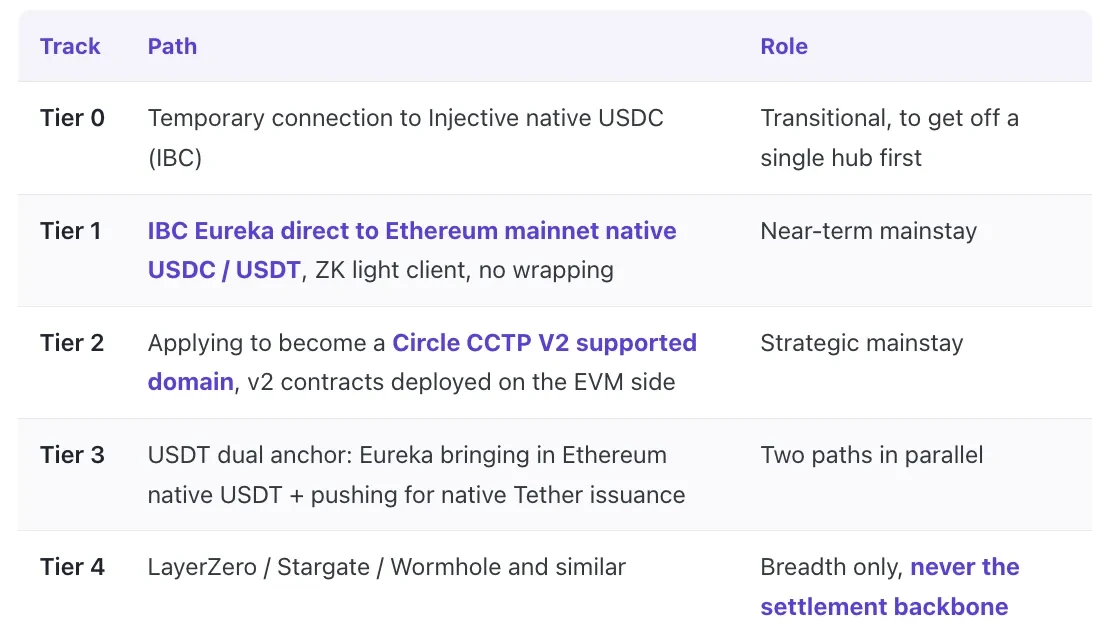
Two design details deserve to be pulled out.First, Tier 4 is explicitly demoted. Almost every chain turns “how many bridges do you support” into a selling point; here bridges are explicitly written down as “not the settlement backbone” — because it has seen too many cases where a bridge went down and the assets went down with it.Second, the dual-VM division of labor is deliberate: the IBC / CosmWasm side receives native EVM stablecoins delivered by Eureka, the EVM side receives CCTP and bridged assets, and both tracks eventually feed the same RWA settlement layer. Not two parallel ledgers — two intake pipes into one reservoir.And it sets a success criterion anyone outside can verify independently: mainnet simultaneously carrying ≥2 independent native stablecoin tracks (USDC + USDT), with inflows through the old channel at zero.The weight of that sentence is this — it doesn’t say “we have achieved diversification.” It hands you a test you can run yourself.6. Economic Discipline: No Tax on ApplicationsThe easiest mistake for infrastructure is to turn itself into a toll booth.Uptick laid down four disciplines for its native token UPTICK, two of which are hard lines:No tax on applications. “Every chain that lived off extraction after FTF proved the same thing: extraction drives the ecosystem to another chain.”Payments settle in stablecoins; bare UPTICK is not a checkout option. Many find this confusing, but separating unit of account from medium of payment is precisely what spares asset issuers from carrying token price volatility.There is also the four-step UGE (chain-level gas rebate) loop: declaration → attribution → settlement → reinvestment.The attitude lives in the details: attribution includes on-chain verification plus a challenge window, and a successful challenge permanently blocks automatic settlement; the incentive source is real business that has already happened, not principal from new entrants; the final settlement entry point is deliberately not exposed as any command-line interface; key parameters are all governed and hardcoding is forbidden; upgrades go through governance proposals plus timelock, and modules can be snapshot-rolled-back themselves.The core of this design: make “can someone tamper with it” structurally impossible, instead of promising nobody will.7. Six Layers: From Governance to Asset Scale-OutStack those capabilities up and Uptick draws its full form in six layers:Press enter or click to view image in full sizeThe top layer (L5) carries what I think is the single most substantial principle in the entire document:The cost of customizing for an asset must not be borne by the asset. Adding a new asset vertical should be a matter of configuration, not rebuilding.That principle ties every technical choice together. Why dual VM, why asset primitives, why compliance as a native module, why attribution and identity get pushed down — all of it serves one goal: make the tenth asset cheaper to bring on-chain than the first. A chain that has to be rewritten for every new asset class will forever remain a custom project, never infrastructure.8. Operating FactsIn infrastructure, nothing you say beats how long you’ve been running. A few verifiable facts:Started in 2021 (from an NFT marketplace), open-sourced under Apache-2.0 in 2022–09, testnet live in 2022–10;Mainnet launched 2023–03, Chain ID 117 (Cosmos chain identifier uptick_117-1), its own namespace;3.5 years of continuous operation since, zero major outages; 21 official releases in total;2025–08 v0.3.0 brought asset primitives and dual-stack capability to completion; 2026–08 v0.4.0 moved the EVM engine onto Cosmos’ official mainline; 2026–09 v0.4.1 delivered the RWA asset layer in full;Code footprint of 166 protocol and infrastructure repositories + 23 application-layer repositories, and then consolidated — 3 empty shells archived, core active repos cut from roughly 29 to roughly 20.That last point says more than a repository count: an organization willing to shrink its repo count is usually actually maintaining them.ClosingBack to that exam.On the surface, public chains compete on spec sheets: TPS, gas, ecosystem size. But once the assets are real, the amounts are real and the regulators are real, the competition becomes something else entirely:Can the title be rolled back, can responsibility be traced, who holds the settlement dependency, how long does the tenth asset take to onboard, and — can the critical parameters be quietly changed at all.Uptick Chain’s foundation was poured layer by layer around those questions: BFT single-block finality, three stacks in parallel that normalize only the minimum credential set, an EVM engine moved onto a maintained mainline, account abstraction erasing the gas threshold, compliant identity bound to addresses, four stablecoin tracks that keep settlement dependency in-house.None of this makes a chain “faster.” It aims at something else: making real assets willing to put their balance sheet on it.

