Web3 Infra Series | The Advertising Extraction Racket | How Platforms
Profit From Your Audience
Published on Dec 23, 2025
When David Ogilvy, British advertising tycoon, walked into his Madison
Avenue office in 1963, advertising operated on a simple principle
where creative agencies built campaigns, negotiated rates directly
with publications and broadcasters, and split revenue roughly 85/15 in
favor of the client whose products generated consumer interest.
The agency received payment for creative services and media placement,
the publication profited from selling page space or airtime, and
brands captured the vast majority of returns from advertising that
built their businesses.
Ogilvy became legendary not by extracting maximum value from clients
but by creating work so compelling that brands willingly paid premium
fees for campaigns that demonstrably increased sales, establishing a
professional service relationship where both parties benefited from
advertising effectiveness rather than one exploiting the other's
dependency.

It was different from today, because the economic arrangement
displayed a fundamental respect for who created value in advertising
ecosystems, as brands building products and agencies crafting
campaigns both contributed essential elements that made advertising
work, sharing rewards proportionally based on their respective
contributions to successful outcomes. Television networks in this era
sold airtime to advertisers and produced shows that attracted
audiences, capturing revenue from both advertising sales and
eventually syndication rights, although they never claimed ownership
over audience relationships brands had built through years of
consistent advertising presence.
If we skip forward sixty years, the fundamental economics have
inverted completely. Now, digital platforms position themselves
between creators and audiences in ways that would probably shock
Ogilvy's generation of advertising professionals who operated under
the assumption that creative labor deserved fair compensation.
YouTubers generate content that attracts billions of monthly viewers,
but the platform takes 45% of ad revenue, leaving creators with 55%,
flipping the historical split where agencies received 15% for
placement services and clients kept 85% of value their brands
generated.
Just this July, YouTube tightened these restrictions further with
policy updates targeting 'unoriginal content' threatening to
demonetize creators who rely on reaction videos, commentary, or
compilations without adding substantial transformation, giving
platforms another mechanism to disqualify revenue-generating content,
but then keeping the advertising dollars those videos produce.

Instagram and TikTok push this exploitation further by keeping 85–100%
of advertising revenue generated by creator content, forcing creators
to monetize through external brand deals, but at the same time, the
platforms are profiting from the attention those creators worked years
to cultivate. TikTok actually shuttered its Creator Fund in December
2023 after years of creator complaints about earning pennies per
million views, replacing it with a Creator Rewards Program featuring
even stricter eligibility requirements that disqualify most creators
who relied on the original fund for income.
Then there was Patreon, who raised its platform fee to 10% for all new
creators starting August 2025, citing 'platform evolution' as
justification for extracting larger percentages from creator earnings,
showing us that even alternative monetization channels steadily
increase extraction rates as creators grow dependent on their
infrastructure.
There is a crystal clear pattern, which is that these actions
represent a massive shift in industry economics, with a fundamental
inversion of who captures value in advertising relationships and a
systematic devaluation of creative labor that produces the content
making these platforms worth hundreds of billions to shareholders.
The creator economy reached around $250 billion in 2025 as
creator-driven platforms surpassed traditional media in advertising
revenue for the first time, marking the moment when individual content
producers collectively commanded more advertising dollars than
television networks, radio stations, and print publications combined.
Despite this unprecedented wealth concentration in creator-driven
content, over half of all creators actually earn less than $15,000
annually, which just goes to show how platforms have completely
engineered economic structures that capture industry growth and
systematically underpay the people whose work generates the audiences
advertisers pay billions to reach.

The earliest internet publishers in the 1990's ran their own
advertising directly through networks like DoubleClick, keeping
control over their businesses and capturing 70–80% of advertising
revenue their content generated. A technology blogger in 1998 could
negotiate rates with advertisers, place banner ads directly on their
site, and keep most of the revenue without intermediary platforms
claiming ownership over audience relationships or behavioral data
generated through years of consistent publishing.
This decentralized model enabled thousands of independent publishers
to build sustainable media businesses, but the infrastructure stayed
disconnected and advertisers had to negotiate separately with each
publisher they wanted to reach, creating a certain level of friction
that would eventually justify platform consolidation.
We then saw the rise of Google's AdSense in 2003, which was a solution
to this disconnection, offering publishers simplified monetization
where they embedded code snippets and Google handled advertiser
matching, payment processing, and revenue distribution.
The initial split appeared fairly reasonable at 68/32 in favor of
publishers, as Google provided genuine value by aggregating advertiser
demand and automating placement logistics that previously required
manual negotiation and ongoing relationship management. Publishers
gained convenience and consistent revenue from content that might
otherwise have remained unmonetized, accepting Google's 32% cut as
fair compensation for infrastructure that demonstrably increased their
earnings compared to direct sales efforts.
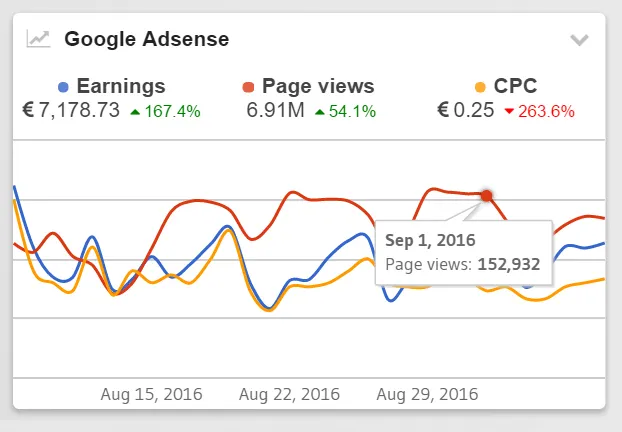
The trap closed slowly as publishers grew dependent on AdSense revenue
and Google leveraged that dependency to extract increasing value, but
providing diminishing returns to the people producing content that
made its advertising network valuable. Publishers watched CPMs decline
as Google optimized for advertiser satisfaction, and the platform
simultaneously accumulated comprehensive behavioral data about who
visited which sites, what content they engaged with, and how they
responded to different advertising messages, building proprietary
datasets that enabled precision targeting worth premium rates to
advertisers as publishers received commodity pricing for
undifferentiated inventory.
Social platforms refined Google's extraction model by eliminating
revenue sharing entirely, as Facebook built a multi-billion dollar
advertising business monetizing creator content for free, but keeping
100% of advertising revenue. The genius was that they somehow
convinced creators that 'free distribution' represented adequate
compensation for content production requiring thousands of hours of
unpaid labor, positioning algorithmic reach as a scarce resource
platforms generously provided rather than acknowledging that creator
content made Facebook valuable to users in the first place.
YouTube's Partner Program launched in 2007 and appeared generous by
comparison with its 55/45 revenue split favoring creators, however
this framing obscured how dramatically the economics had shifted from
historical norms where creative agencies captured 15% for placement
services rather than 45% for hosting infrastructure.
The platform successfully reframed creator expectations by positioning
itself as a partner rather than a landlord, convincing millions of
content producers that keeping just over half of revenue they
generated represented a fair deal despite YouTube contributing nothing
to the creative process that made the content valuable.
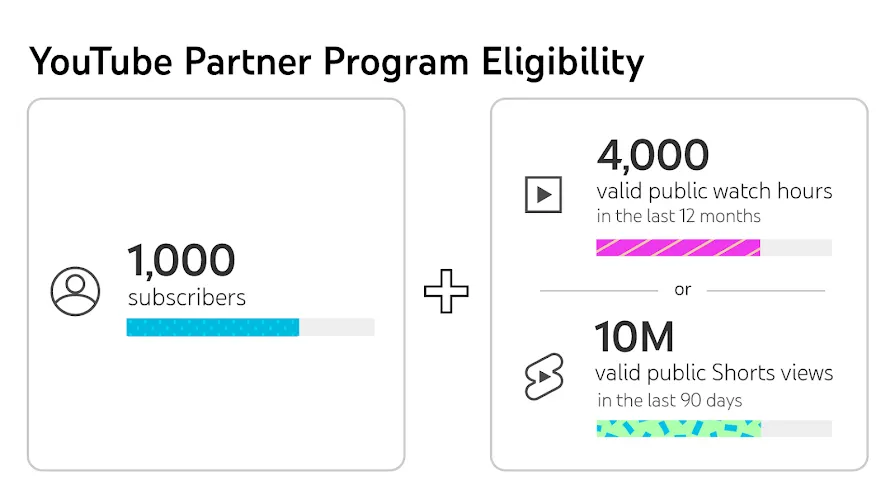
Final boss, TikTok would later push exploitation to new extremes
through its Creator Fund that distributed literal pennies to creators
generating billions in advertising revenue before abandoning the
program altogether in December of 2025, leaving millions of creators
who built audiences on promises of monetization with no compensation
path except the even more restrictive Creator Rewards Program that
disqualifies most applicants.
The deeper injustice isn't the advertising revenue splits, but the
comprehensive behavioral data that platforms accumulate through
creator-audience relationships they never built, capturing the most
valuable asset in digital advertising.
This is all while compensating creators zero for data their work
produces.
Every subscriber, view, like, comment, and share creates data points
platforms aggregate into detailed audience profiles that enable the
precision targeting advertisers pay billions to access, building
datasets worth more than the advertising revenue they generate because
behavioral intelligence compounds in value as it accumulates.
A YouTuber who spends five years building an audience of 500,000
engaged subscribers in a specific niche produces thousands of
behavioral data points per viewer through content that educates
preferences, surfaces interests, and demonstrates purchasing intent.
Through years of community interaction, that creator develops granular
audience intelligence, learning their audience prefers specific
product categories like mechanical keyboards, watches content at 1.5x
speed, engages heavily in comments about technical details like keycap
materials, and converts at high rates on product recommendations.
This knowledge comes from direct relationship-building, reading
thousands of comments, analyzing which videos resonate, and
understanding the community's evolving interests.
The platform, however, possesses exponentially more granular
intelligence on that same audience, tracking every second of watch
time, correlating viewing patterns with searches and purchases across
Google's advertising network, and building predictive models that
determine which specific viewers will respond to particular
advertising messages with enough precision to justify charging
advertisers premium CPMs for guaranteed reach.
Where the creator knows their audience through relationship and
observation, YouTube knows them through comprehensive surveillance,
capturing behavioral signals the creator never sees and aggregating
them into audience profiles worth far more than any individual video's
ad revenue.
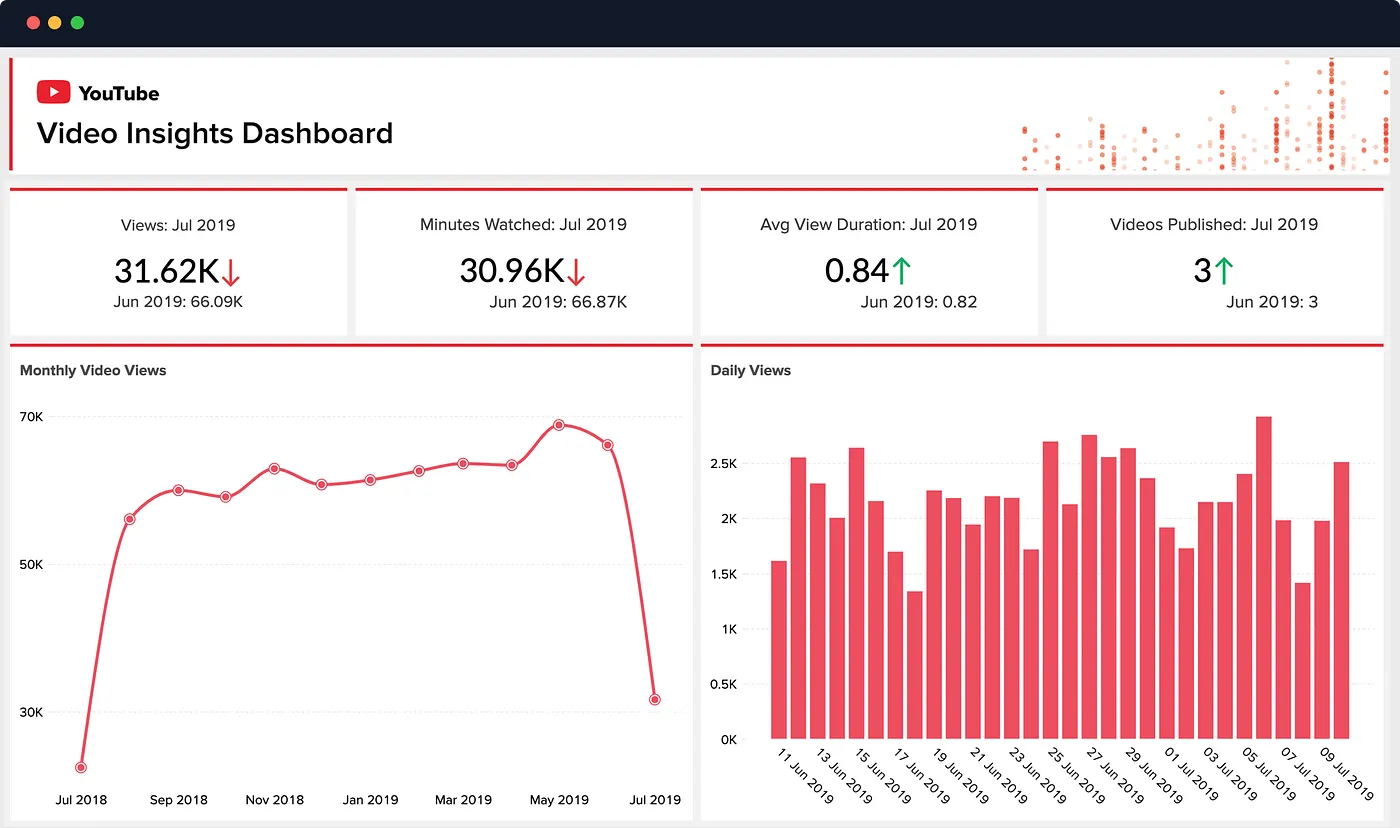
This creates asymmetric warfare where creators negotiate sponsorships
based on subscriber counts and rough engagement metrics, and YouTube
sells access to the same audience at multiples higher based on
behavioral targeting capabilities built entirely from data the
creator's work produced.
The injustice compounds across platforms as creators duplicate effort
to reach audiences broken up across YouTube, Instagram, TikTok, and X,
producing platform-specific content optimized for different formats
and algorithmic preferences as each platform accumulates separate
behavioral datasets it monetizes without compensation.
A podcaster records their show, creates a YouTube version with video
elements, cuts vertical clips for Instagram and TikTok, writes X
threads summarizing key points, and posts to Facebook to reach
audiences distributed across five platforms that refuse to acknowledge
identities exist outside their walled gardens.
Just think about what platforms actually know compared to what they
share with creators who generate the underlying data through years of
content production and community building. Instagram tracks which
Stories drive profile visits and measures exactly how long viewers
watch before swiping away, Facebook correlates post types with
extended engagement patterns and knows which content formats drive the
highest-value actions, and TikTok analyzes viewing patterns down to
the fraction-second when attention drops and uses this intelligence to
optimize its recommendation algorithm.
In contrast, creators receive simplified analytics dashboards showing
aggregate metrics like total views and average engagement rate, losing
access to the granular behavioral intelligence their content produces
and that advertisers pay billions to leverage through platform
targeting systems.
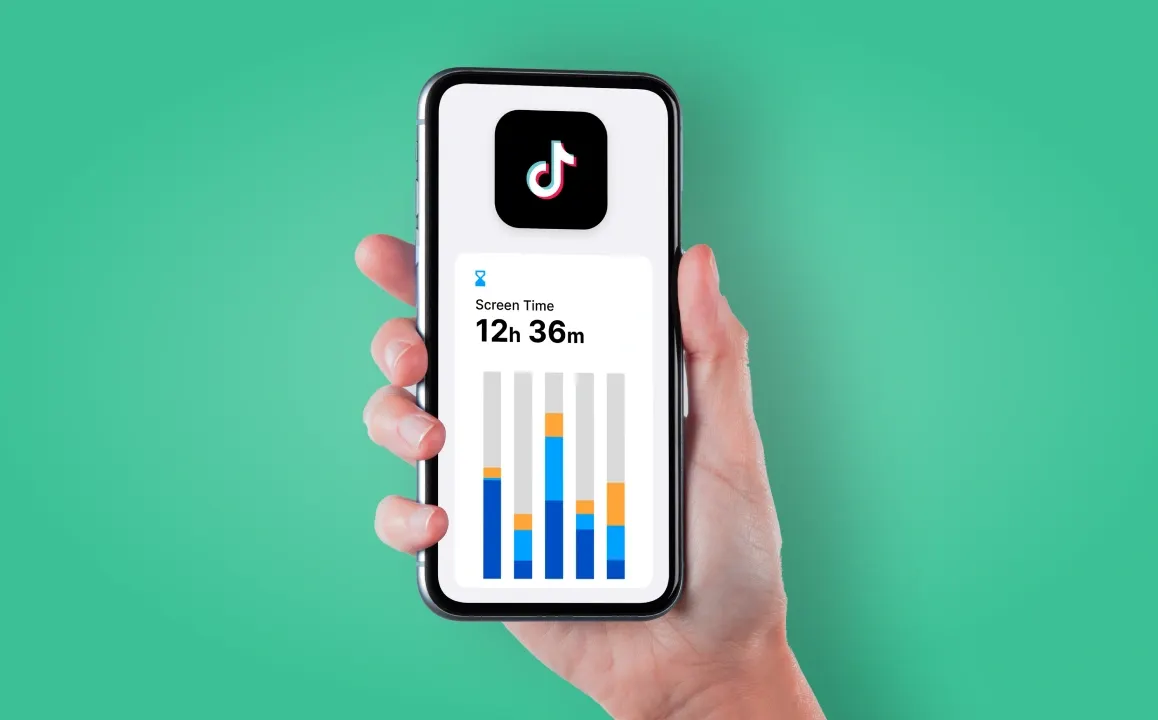
This data monopoly creates a permanent economic disadvantage for
creators attempting to monetize directly through brand partnerships,
as they simply lack the behavioral intelligence needed to command
premium rates from advertisers who can access exponentially better
targeting by buying through platform advertising systems.
The asymmetry guarantees platform dominance in advertising markets
because creators competing for direct deals can't offer the precision
targeting platforms provide using data those same creators produced,
creating a structural lock-in where the more successful a creator
becomes at building engaged audiences, the more valuable their data
becomes to the platforms.
The gap then grows even larger between what creators could earn with
data access versus what they capture through platform revenue sharing
that continuously shrinks as policies tighten and eligibility
requirements multiply.
Early internet architects believed that peer-to-peer networks would
enable direct value exchange without intermediaries extracting rent
from transactions they enabled but didn't create, envisioning digital
worlds where creators and audiences could interact directly without
platforms positioned as permanent middlemen claiming ownership over
relationships they never built.
These principles remained mostly theoretical until Web3 provided the
infrastructure to make decentralization practically viable, creating
systems where mathematical verification replaces institutional trust
and automated execution via smart contracts eliminates the need for
intermediaries to process transactions or control access to digital
infrastructure.
The application to creator economics becomes obvious once you
recognize that platforms don't provide irreplaceable value but rather
perform specific functions like hosting content, processing payments,
and aggregating audience data, all of which can operate through
decentralized protocols that serve creators rather than extract from
them.
Content hosting, payment processing, and data management can all work
through decentralized protocols without platform intermediaries, and
the technical architecture enables creators to actually own the
infrastructure they operate on rather than renting from platform
monopolies engineered to extract maximum value from permanent tenants
who can never accumulate equity in systems they make valuable through
years of content production.

This matters because ownership structure determines who captures value
as businesses grow, a lesson founders understand viscerally but that
creators operating on platform infrastructure somehow accept despite
building businesses worth potentially millions over decades of
consistent work.
There could be a YouTuber with a million subscribers that has built an
asset worth substantial money, but they actually own nothing except
the ability to keep producing content and hope YouTube doesn't change
policies that destroy their monetization overnight, which actually
happened to thousands of creators when the July 2025 'unoriginal
content' policy suddenly disqualified revenue streams creators spent
years developing.
Decentralized infrastructure inverts this relationship by giving
creators genuine ownership over audience data, content distribution,
and monetization infrastructure that appreciates in value as their
businesses grow, rather than enriching platforms that claim permanent
ownership over digital relationships and unilaterally change terms
whenever shareholder interests demand greater extraction.
The core problem isn't that 'creators need more tools', it's that
every dollar and datapoint currently flows through platforms that own
the pipes, the ledgers, and the relationships. The only way to reverse
this extraction logic is to rebuild those pipes so that audience data,
relationships, and payments terminate with the creator instead of the
platform.
Uptick infrastructure is designed specifically as that alternative
stack, with a thick protocol layer that handles data, identity, and
payments, and thin applications that creators and partners can
customize without ever giving up control again.
Building a data layer creators actually own
On Web2 platforms, all the compounding value sits in behavioral data
warehouses the creator never sees, with watch curves, click paths,
cross‑device identities, and purchase correlations that platforms sell
back to brands at a premium, but sharing only CPM scraps with
creators.
A sovereignty‑aligned replacement can flip that using granular
intelligence that pools with the person who actually generated the
attention.
Uptick's Decentralized Data Service (UDS) enables this by storing
sensitive and behavioral data off‑chain with IPFS, with access that is
controlled cryptographically at the edge, so data can be queried and
monetized without ever being centralized inside a YouTube‑style
surveillance database.
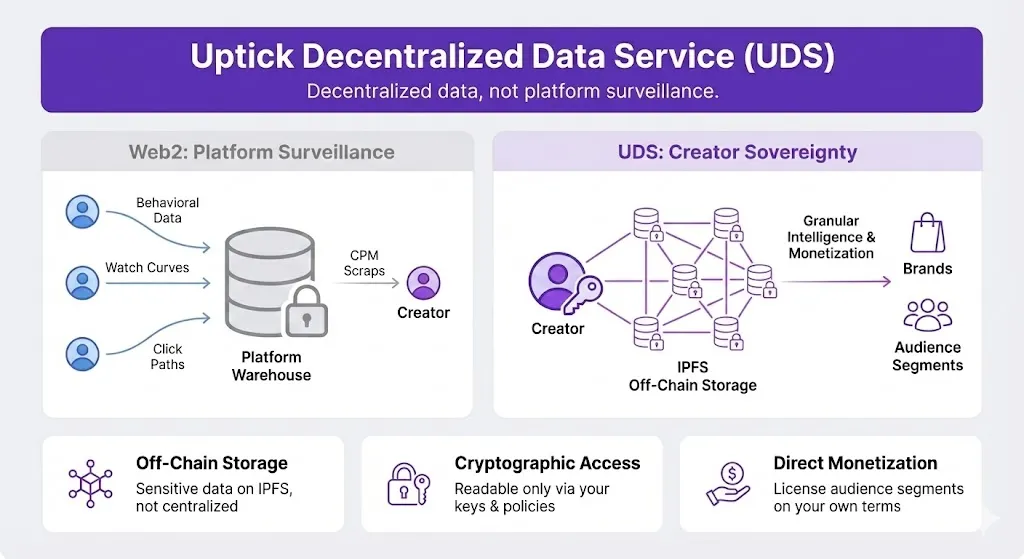
In practice, a musician or commentator with different audiences on
Spotify, YouTube, and Instagram could sync event streams into a
unified, creator‑owned data vault, indexed via UDS but readable only
via their keys and policies, so instead of platforms renting out that
audience intelligence to advertisers, the creator licenses specific
audience segments on their own terms.
For example, highly engaged fans in North America who consistently
interact with new releases, with every query resolved against
decentralized storage they control.
Owning the audience relationship layer
Today, 'audience relationship management' lives inside YouTube Studio,
Meta Business Suite, TikTok dashboards, and Patreon backends, all of
which can be throttled, repriced, or deplatformed at will. That's why
creators feel like suppliers whose customer relationships belong to
someone else, where the customer data, the analytics, and the
communication channels all stay as platform property.
Uptick's Decentralized Customer Relationship Management (DCRM) is
built as the opposite, where the data sits on decentralized storage
like IPFS, keyed to decentralized identities, and governed by smart
contracts the creator controls.
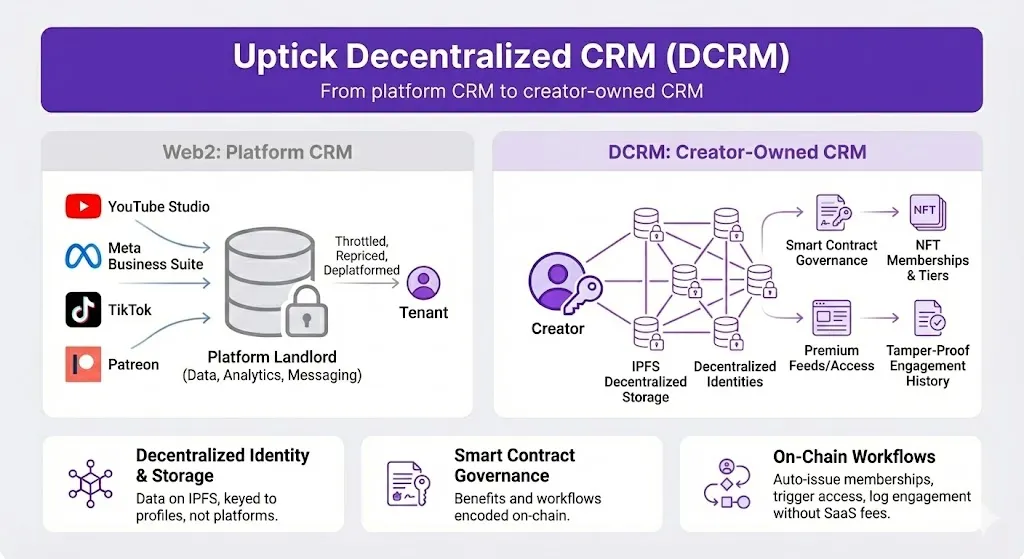
For a podcaster, that means audience 'tiers' become NFT based
memberships tied to their decentralized profiles, with benefits and
workflows encoded on-chain rather than in Patreon's backend. When
someone crosses a support threshold, DCRM could automatically issue or
upgrade a membership NFT, trigger access to premium feeds, and log
engagement in a tamper proof history, all without any SaaS
intermediary claiming 10 to 30 percent for running a database and
sending emails.
One identity that travels everywhere
The fragmentation problem, where one fan turns into five different
'users' across YouTube, Instagram, TikTok, X, and podcast apps, is not
an accident, it's how platforms prevent portability of audiences and
keep creators locked in. Creator sovereignty requires a single,
portable identity layer that follows people across applications
without letting any single platform become the identity provider.
Uptick DID implements decentralized identifiers to do exactly that,
following W3C standards so that a fan can carry the same verifiable
persona into any compatible app or interface.
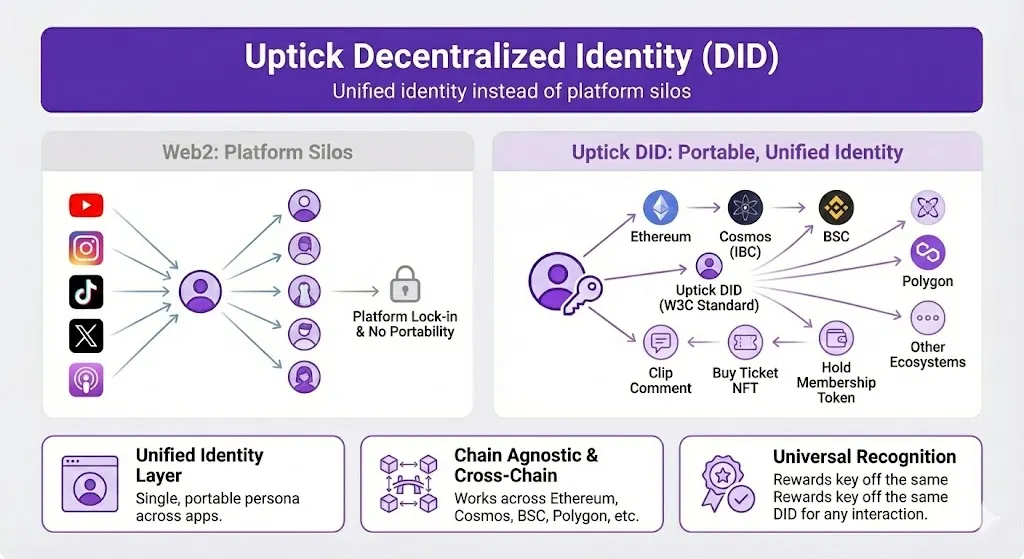
For creators, this means recognition and rewards can key off the same
DID whether a supporter is commenting on a clip, buying a ticket NFT,
or holding a membership token. Because these identifiers are chain
agnostic and cross-chain capable through Uptick's Cross-chain Bridge
and IBC infrastructure, credentials and memberships can live across
Ethereum, Cosmos-based chains, BSC, Polygon, and other ecosystems
without recreating silos or rebuilding the same lock in that Web3 is
meant to remove.
Making reach a tokenized asset creators control
Advertising extraction works because 'reach' is an opaque asset priced
and sold by platforms, and creators simply receive remittances. If
creators are going to reclaim that value, reach itself has to be
something they can define, tokenize, and sell directly.
Uptick's programmable NFT protocol and Omnichannel Payment Module
provide that substrate, where NFTs can represent concrete, verifiable
slices of audience access and payment flows can be encoded in smart
contracts instead of hidden inside AdSense.
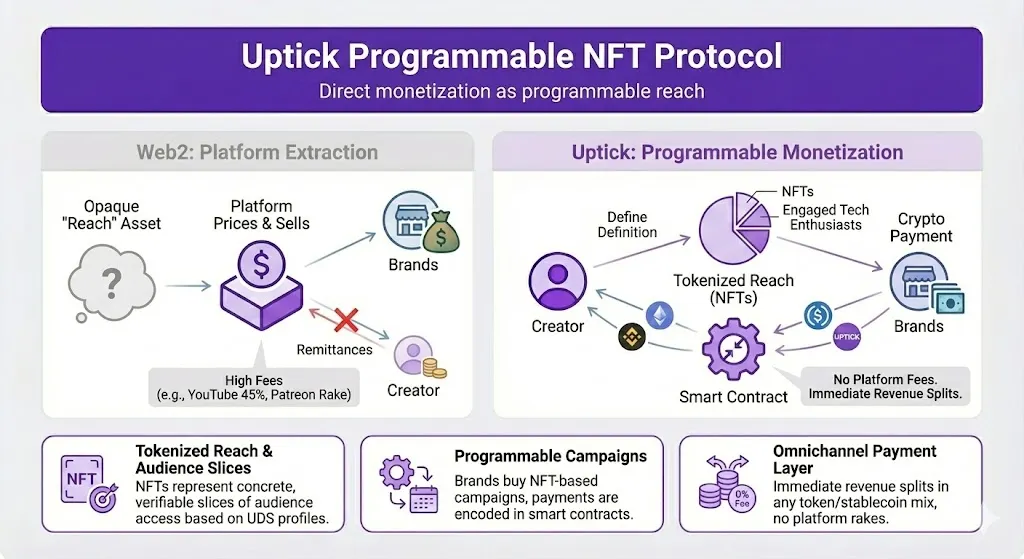
A channel with 500,000 subscribers and rich UDS-backed behavioral
profiles could mint NFTs that embody specific audience segments, such
as highly engaged tech enthusiasts with demonstrated purchase history,
and brands could buy those tokens as programmable campaigns.
The omnichannel payment layer then executes revenue splits immediately
when those contracts fire, in whatever mix of tokens or stablecoins
the parties agree on, with no YouTube style 45 percent fee or Patreon
style rake on gross receipts.
Turning platform margins into on-chain logic
Platforms justify their 45 to 85 percent cuts with two claims, that
creators need trust, such as whether the brand will pay and whether
metrics will be honest, and that creators need back office automation,
such as billing, reconciliation, refunds, and chargebacks.
Smart contract infrastructure makes both arguments structurally
weaker.
Uptick's payment framework is built to automate multi party
distribution, record every transaction on a tamper resistant ledger,
and route funds across chains without relying on a central processor
that can change terms unilaterally.
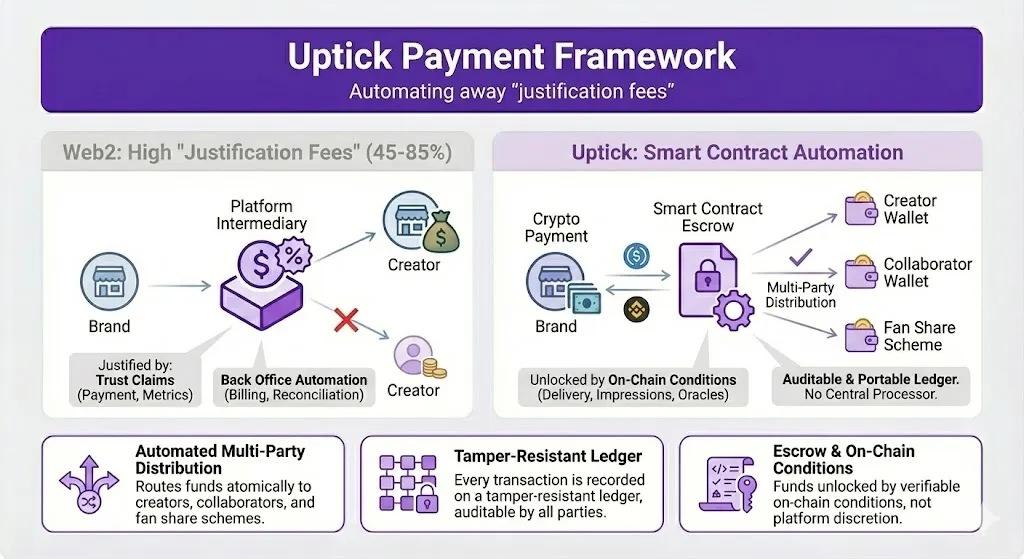
In a sovereignty aligned stack, a brand buying audience access,
sponsorship slots, or token gated experiences interacts with code
rather than a platform intermediary, so funds are escrowed in
contracts, unlocked by on-chain conditions such as delivery,
impressions, or oracles, and distributed atomically to creator
wallets, collaborators, and even fan share schemes, all of which
remain auditable and portable if the creator ever changes front end
applications.
If platforms extract value by turning attention and data into assets
they own, the logical endgame for a creator sovereign stack is to make
audiences partners in that upside instead of invisible inputs.
Audiences already fund creator businesses with time, data, and social
proof, but in the current model they receive nothing when a channel
explodes or a show lands major sponsors. Turning those same
contributions into on-chain positions lets the people who power the
metrics share in the economics instead of watching platforms and
agencies capture all of it.
Programmable NFTs make that shift practical because they let creators
encode rights, rewards, and upside participation directly into tokens
that fans can hold. For example, a musician just starting out could
issue a fixed set of audience tokens that represent a share of future
sponsorship or advertising revenue, so early supporters are not simply
buying merch, they're taking a stake in the growth of the project and
capturing upside as the audience and revenue expand.
Rewarding attention and data directly
Right now, every like, view, share, and comment feeds behavioral
datasets platforms sell to advertisers, and both creators and
audiences are cut out of the data revenue entirely. If behavioral
intelligence is the real asset in digital advertising, a fairer system
has to route part of that value back to the people whose actions
generate it.
Uptick infrastructure is designed to enable creators to issue rewards
that flow automatically to audience wallets when they watch, interact,
or contribute data under transparent terms instead of opaque platform
tracking.
When a brand buys access to a creator's audience through this stack,
smart contracts can split that payment three ways in a single
transaction, sending the lion's share to the creator, a defined
portion to token holding audience members whose engagement and data
drove the value of the placement, and a modest fee to the underlying
infrastructure.
The economic logic flips from one platform capturing everything to a
coordinated value share between the people who produce, the people who
participate, and the protocol that routes the money.
Letting communities steer what they fund
Platforms talk about community, but proceed to keep all of the genuine
power over formats, policies, and distribution, which is why a single
policy change at YouTube or TikTok can wipe out entire creator
business models overnight. If audiences are going to be treated as
stakeholders instead of raw material, they also need structured ways
to influence what they are helping build.
Uptick's Social DAO tooling gives creators a way to formalize that
influence, letting token holders propose and vote on topics, formats,
guests, or new product lines in ways that are completely transparent
and enforceable on-chain.
A podcast community, for example, could run a DAO where supporter
tokens grant the ability to vote on upcoming guests, decide which
series to expand, or allocate part of the show's revenue into
experiments the community wants to see. Because the relationships,
data, and monetization live on creator controlled infrastructure
rather than inside YouTube or Patreon, these communities stay intact
even if a platform changes its rules, demonetizes a format, or shuts
down a fund, turning what used to be parasocial 'engagement' into an
actual shared project with shared economics.
Creator economics under platforms isn't broken, it's actually working
exactly the way the infrastructure was designed.
Centralized systems route every dollar and datapoint through a small
set of companies that sit between creators and audiences, treat
attention and behavioral data as their own balance sheet assets, and
tighten terms once dependency is secured.
Changing that outcome means changing the rails rather than waiting for
a friendlier version of the same model. Infrastructure where data,
identity, monetization, and governance terminate with creators and
their communities produces different economics by default, because
there is no central ledger that can quietly rewrite splits or revoke
access once a business is built.
In this article, we've shown that each layer of that alternative stack
can map to a specific failure in the current system.
Data that lives in creator controlled vaults instead of platform
warehouses, audience relationships that move with DID rather than
staying trapped in subscriptions and follows, payments that clear
through code instead of opaque internal accounting, and audiences who
hold tokens that define both upside and voice.
Once those foundations exist, losing a recommendation slot or a
creator fund is painful but not existential, because the business is
no longer defined by a single company’s policy document. The practical
decision for creators is whether to keep compounding value on rented
infrastructure that is structurally incentivized to extract more each
year, or start compounding it in systems where ownership and upside
sit with the people actually doing the work.